Drainage Holes: Why They Matter
No drainage = no escape for excess water = drowned roots. It's not optional and no amount of rocks at the bottom substitutes for actual holes.
Potting Corner Team · Feb 5, 2026 · Updated Feb 5, 2026 · 8 min read
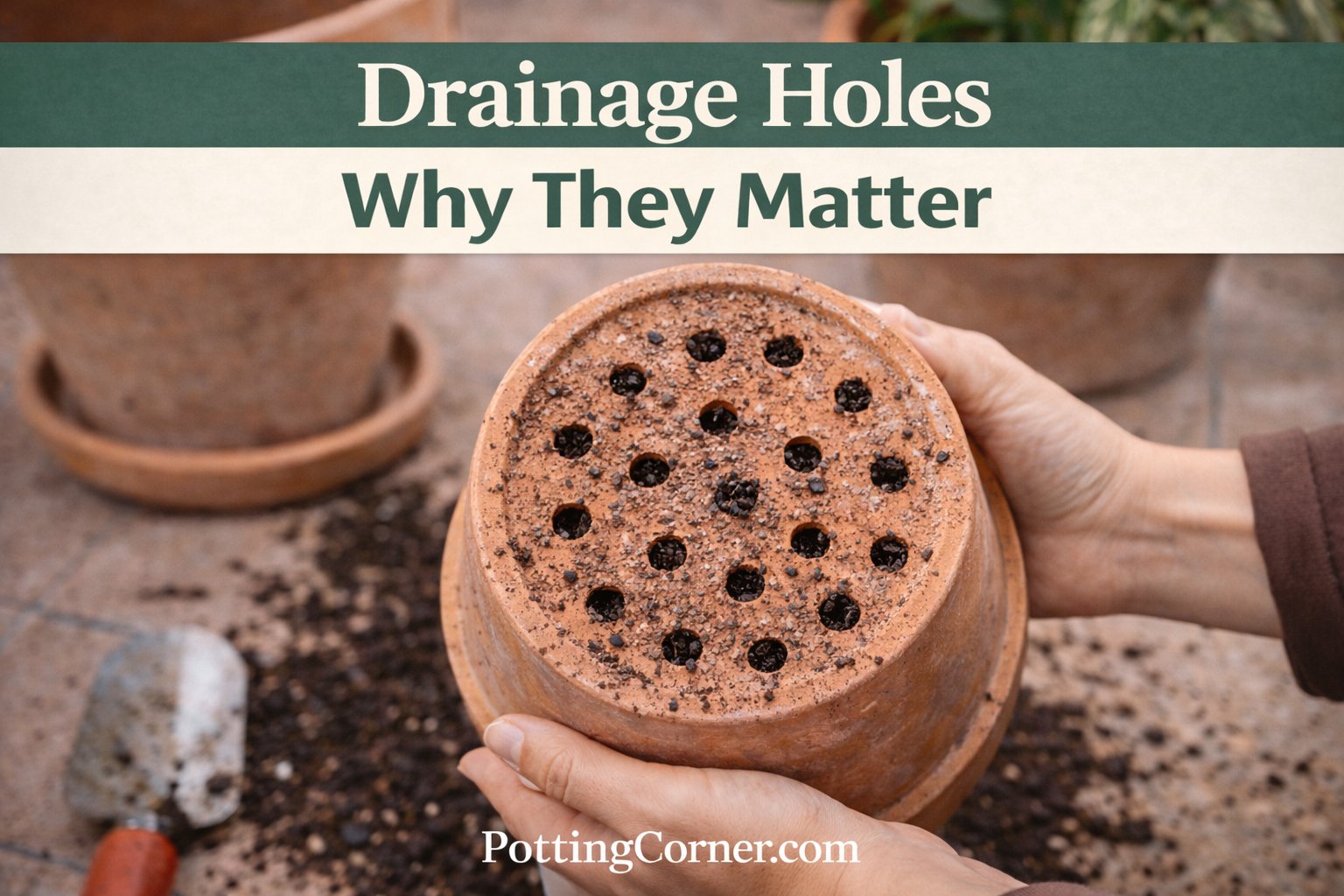
Drainage holes let excess water escape from the pot. Without them, water collects at the bottom soil stays saturated and roots rot. This isn't a minor concern, pots without drainage are the single biggest cause of houseplant death from overwatering. Every pot should have drainage holes. No exceptions.
This guide explains why drainage is non-negotiable and how to work around pots that lack it. For watering fundamentals, see How to Water Houseplants.
The Direct Answer: Always Use Drainage
| Pot Type | Recommendation |
|---|---|
| Pot with drainage holes | Use directly |
| Decorative pot without holes | Use as cachepot only |
| Pot you can drill | Add holes yourself |
| Pot you can't drill | Don't plant directly in it |
The rule: Plant in pots with drainage. Use decorative pots without drainage as outer covers only.
What Happens Without Drainage
Water Has Nowhere to Go
When you water a pot without drainage:
- Water fills soil from the top
- Gravity pulls water downward
- Water collects at the bottom with no exit
- A saturated zone forms at the pot's base
- More waterings add more water
- The waterlogged layer grows deeper
Even "careful" watering accumulates over time. There's no margin for error.
Roots Suffocate
Roots need oxygen from air spaces in soil. When those spaces fill with water:
- Oxygen can't reach root cells
- Roots can't perform essential functions
- Cells begin to die
- The dying tissue becomes vulnerable to fungal attack
This process starts within days of continuous saturation.
Root Rot Takes Over
Once roots are oxygen-deprived, opportunistic fungi move in:
- Pythium, Phytophthora and other rot fungi thrive in wet, low-oxygen conditions
- They consume dead and dying root tissue
- Rot spreads to healthy tissue
- Eventually the entire root system is compromised
See Root Rot: How to Identify and Save Your Plant for identifying and treating rot.
The Plant Dies Slowly
Above ground, you'll see:
- Yellowing leaves
- Wilting despite wet soil
- Soft, mushy stem base
- Foul smell from soil
- Eventually, plant collapse
By the time these symptoms appear, serious root damage has already occurred. Prevention through proper drainage is far easier than treatment.
The "Drainage Layer" Myth
A persistent myth claims that adding rocks, gravel, or pottery shards to the bottom of a pot without drainage holes creates a "drainage layer" that prevents waterlogging.
This is false.
What Actually Happens
When water moves through soil it doesn't flow freely into the drainage material below. Instead, physics creates a "perched water table"—a zone of saturated soil directly above the drainage layer.
Water won't move from fine particles (soil) to coarse particles (rocks) until the soil is completely saturated. The result:
- Soil above the rocks stays wetter not drier
- Roots have less usable soil depth
- The problem is worse than having no layer at all
The Evidence
This phenomenon is well-documented in soil science. You can test it yourself: fill a pot with soil add a layer of gravel below it, water and observe. The soil stays wetter longer than soil in a pot with actual drainage holes.
What Rocks Are Actually For
If you want to cover drainage holes to prevent soil from washing out, a single piece of mesh or a coffee filter works. Rocks on top of holes can actually block drainage. Rocks below soil don't help at all.
How Drainage Holes Work
Proper drainage creates a path for excess water:
- You water the plant
- Water saturates the soil briefly
- Gravity pulls water downward
- Excess water exits through drainage holes
- Air moves back into soil pores
- Roots access both water and oxygen
This cycle is essential for healthy roots. No amount of careful watering replicates the safety margin that drainage provides.
Working with Pots Without Holes
Sometimes you fall in love with a pot that has no drainage. Here's how to make it work safely.
The Cachepot Method
A cachepot is a decorative outer pot that holds a functional inner pot:
- Keep your plant in its nursery pot or any pot with drainage
- Set that pot inside the decorative cachepot
- Water in a sink, let drain completely, then return to cachepot
- Or water in place but check and empty any collected water after 30 minutes
This gives you the look you want with the drainage you need.
Drilling Your Own Holes
Many pots can be drilled:
Terracotta and unglazed ceramic: Use a masonry bit at low speed with water for cooling
Plastic: Use a regular drill bit or a heated metal object
Glazed ceramic: More challenging, use a diamond-tipped bit with water, go slowly
Glass: Very difficult, high breakage risk
Always wear eye protection and work over a stable surface. Start with a small pilot hole and enlarge gradually.
What About "Water Carefully"?
Some advice suggests you can water pots without drainage if you're extremely careful, measuring exact amounts, never giving too much.
In practice:
- It's exhausting to measure perfectly every time
- There's no margin for error
- Salt and mineral buildup can't be flushed
- One mistake starts a rot process
It can work for some people with some plants temporarily but it's high risk. The cachepot method is safer and barely more effort.
Pot Selection for Good Drainage
When buying pots, check for drainage before purchasing.
What to Look For
- One or more holes in the bottom: One central hole is minimum; multiple holes are better
- Hole size: Large enough that debris won't easily clog them
- Saucer included: A matching saucer to catch runoff is convenient
Materials That Breathe
Some pot materials allow air and moisture exchange through their walls:
- Terracotta: Very porous, dries faster, helpful for overwatering-prone plants
- Unglazed ceramic: Similar to terracotta
- Fabric pots: Highly breathable, dry fast
- Wood: Breathes but can rot
Even with breathing walls, drainage holes are still necessary.
Materials That Don't Breathe
- Plastic: Non-porous, retains moisture
- Glazed ceramic: Non-porous
- Metal: Non-porous, can heat up
- Glass: Non-porous, often without holes
These pots require drainage holes even more critically because moisture can only exit through the bottom.
See Choosing Pots for Houseplants for comprehensive pot selection guidance.
Managing Saucers and Runoff
Drainage holes need somewhere for water to go.
Using Saucers
A saucer catches runoff so water doesn't damage furniture. But:
- Empty saucers within 30 minutes of watering
- Never let pots sit in collected water
- Sitting water defeats the purpose of drainage
Pot Risers and Feet
Pot feet or risers lift the pot off the saucer surface, creating airflow and preventing the pot from sitting in water. This is especially helpful for larger pots that are hard to lift and empty.
Watering in the Sink
For small to medium pots:
- Take the plant to the sink
- Water thoroughly
- Let it drain completely (5-10 minutes)
- Return to its spot
This eliminates saucer management entirely.
Common Mistakes
Believing the Gravel Myth
Adding rocks to the bottom of a pot without drainage doesn't help it makes drainage worse by creating a perched water table.
Assuming Holes Can Wait
"I'll drill holes later" often becomes never. Plant in pots with drainage from the start.
Forgetting to Empty Saucers
A pot with drainage holes is still problematic if it sits in a saucer full of water. The drainage can't work if there's nowhere for water to go.
Thinking Less Water Compensates
Even tiny amounts of excess water accumulate in pots without drainage. "Just a little" every few days still builds up.
Using Pots with Blocked Holes
Dirt, roots, or debris can clog drainage holes. Check periodically that water flows freely.
Frequently Asked Questions
Can I use a pot without holes for succulents since they need less water?
It's higher risk even for succulents. They need infrequent watering but when watered they still need drainage. Many succulents die in pots without holes because one overwatering is all it takes.
Do self-watering pots need drainage holes?
Self-watering pots have reservoirs that feed water to soil from below. They're designed as closed systems and don't need external drainage the same way but they require careful management. See .
Is one drainage hole enough?
One hole is adequate for most pots. Multiple holes reduce clogging risk and improve drainage flow but one functional hole is far better than none.
Why do some nursery pots have so many holes?
Commercial growers want maximum drainage and airflow for efficiency. More holes reduce overwatering risk during mass production.
Can roots grow out of drainage holes?
Yes and it's often a sign the plant needs repotting. Trim roots that escape, or repot into a larger container.