Brown or Black Spots on Houseplant Leaves: Fungal Leaf Spot and Look-Alikes
Round brown spots with yellow halos that keep appearing on wet leaves usually mean leaf spot disease. Here's how to rule out sunburn, cold damage, edema and fertilizer burn, and a treatment that works whether the cause is fungal or bacterial.
Potting Corner Team · Oct 15, 2026 · Updated Oct 15, 2026 · 9 min read
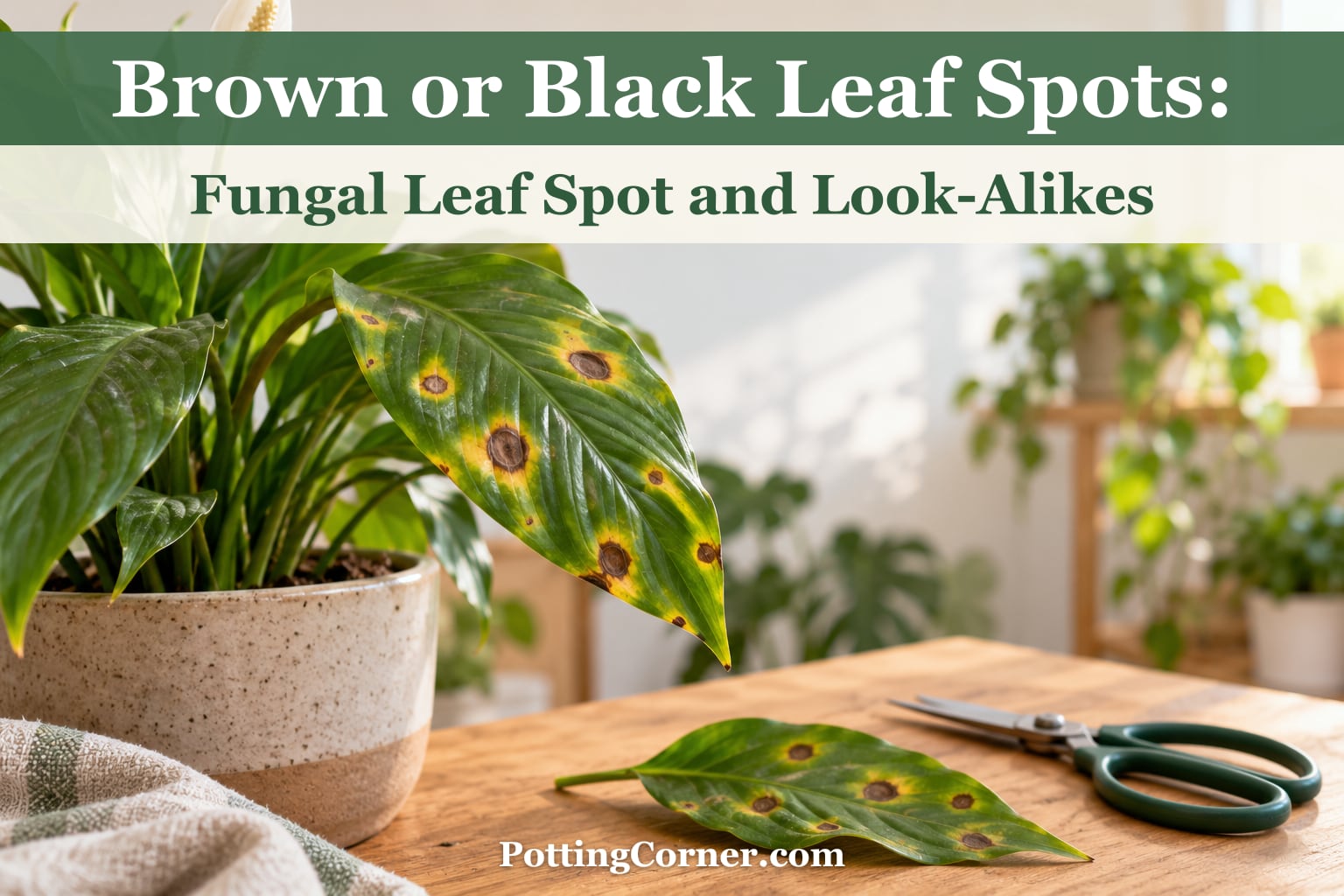
Short answer: brown or black spots scattered across houseplant leaves, often with a yellow edge, that keep multiplying when the leaves stay wet are usually a leaf spot disease. It can be caused by fungi or bacteria, and you can't reliably tell which at home. Luckily the treatment is the same: isolate the plant, cut off spotted leaves, stop misting and wetting the foliage, water at the soil early in the day and improve air flow. Before treating, rule out the common non-infectious causes: sunburn, cold damage, edema and fertilizer burn. Clemson Extension notes that diseases are not common on most indoor houseplants, so these environmental causes are often the real answer.
Plant Doctor
Not sure what's causing the spots? Upload a photo and answer 3 quick questions.
For a broader overview of plant problems, see Houseplant Troubleshooting: Common Problems and Fixes.
The Direct Answer: Is It Leaf Spot Disease?
| What to check | Leaf spot disease | Probably something else |
|---|---|---|
| Where the spots are | Scattered over the leaf blade, on leaves of different ages | Only tips and edges, or only the sun-facing side |
| Shape and edge | Roughly round, often with a yellow halo | Irregular bleached patches, or raised bumps |
| Over the next 1-2 weeks | New spots keep appearing; old ones grow and merge | Damage appeared all at once and stopped |
| Leaf wetness | Leaves are misted, showered or often wet | Leaves stay dry |
| Close-up | Tiny black dots or rings in older spots | Plain dry tissue, corky bumps or a white crust on the soil |
The rule: spots that keep spreading on leaves that stay wet point to disease. Spots that appeared once, right after a move, a cold snap or a heavy feed, and then stopped, point to an environmental cause.
What Leaf Spot Disease Looks Like
Fungal leaf spot (including anthracnose)
- Many tan, reddish-brown or black, roughly circular spots that can run together (University of Maryland Extension)
- Small brown spots with yellowish margins (Clemson)
- Larger spots can show light and dark rings like a bull's-eye, and tiny black dots of fungal fruiting bodies, sometimes in rings (UF/IFAS)
- Spots can merge into large irregular dead areas and cause leaf drop (University of Maryland)
Anthracnose is a fungal leaf spot that often starts at the leaf tip or edge. Clemson describes tips turning yellow, then tan, then dark brown. UF/IFAS describes tan, water-soaked spots with a yellow halo along the leaf edge and black specks in concentric rings. It's managed exactly like other fungal spots, so it doesn't need separate treatment.
Bacterial leaf spot
- Dark green, water-soaked spots that turn tan, dark brown or black with a yellow border (UC IPM)
- Spots usually uniform in size (Clemson), often angular between veins or V-shaped from the leaf edge (University of Maryland)
- Collapsed tissue can be soft and mushy with a rotten smell (University of Maryland); UF/IFAS describes a "rotten, fishy smell" for bacterial soft rot
- Spot centers can fall out, leaving holes (University of Maryland)
UC IPM lists Xanthomonas bacteria on dieffenbachia, heartleaf philodendron, English ivy and pilea, and Pseudomonas on aglaonema, dracaena, monstera and pothos.
Fungal or Bacterial? The Honest Answer
The clues above lean one way or the other, but they overlap. Anthracnose can also look water-soaked with a yellow halo, and bacterial spots can dry out and look like fungal ones. There is no simple home test that settles it, and a photo can't either.
That's why the treatment below is built to work for both. Removing spotted leaves, keeping foliage dry and improving airflow are recommended for fungal and bacterial spots alike by Clemson and the University of Maryland. If you use a spray, Clemson lists copper soap and Bacillus amyloliquefaciens for both fungal and bacterial leaf spots.
Treat it as bacterial and act faster if spots look greasy or see-through against the light, tissue turns mushy or smells rotten, or spots spread within days.
Rule Out the Look-Alikes First
| Cause | What you see | How to tell it from leaf spot disease |
|---|---|---|
| Fungal leaf spot | Round tan to black spots, yellow halos, black dots | Keeps spreading while leaves stay wet |
| Bacterial leaf spot | Dark, water-soaked, angular or V-shaped spots | Greasy look, can turn mushy and smell rotten; spreads fast |
| Sunburn | Tan or white patches | Only on leaves in direct sun from a south or west window (Missouri Botanical Garden); no halos, doesn't spread |
| Cold damage | Blotches or dark patches after chilling; white or straw-colored spots where cold water splashed | Appears after cold exposure below 50°F (UC IPM) or cold water on the leaves (Clemson), then stops |
| Edema | Wart-like or crusty raised bumps | Bumps are on the leaf underside (University of Maryland), not flat spots |
| Fertilizer burn | Brown, dry tips and margins | Tips and edges on many leaves, often with a white crust on the soil (Clemson, University of Maryland) |
If bleached patches showed up after a move to a brighter window, see How to Tell If Your Plant Is Getting Too Much Sun. If the browning is only at the tips and edges, start with Brown Leaf Tips: Causes and Fixes.
Why Leaf Spots Start
UC IPM notes that leaf spot fungi are generally spread by splashing water carrying their spores. The conditions that favor fungal and bacterial spots are the same:
- Wet leaves from misting, showering or overhead watering
- Humid, still air around crowded plants
- Cool temperatures. Clemson advises avoiding low temperatures for bacterial spots
- New plants that bring the disease with them
How to Treat Leaf Spots: Treatment Schedule
Day 0: Isolate, remove and dry out
- Move the plant away from other plants
- Cut off spotted leaves, or the badly spotted part of a large leaf, and bag them. Wipe the scissors with rubbing alcohol between cuts and wash your hands afterward
- Stop misting and showering the plant. Water at the soil only, early in the day, so any splashed leaves dry quickly (University of Maryland)
- Space plants apart so air can move between them
- If spots look bacterial, keep the plant warm and away from cold windows
Day 1: Optional spray if spots keep spreading
The University of Maryland notes that in most homes, removing infected leaves and drying conditions out should be enough. If new spots keep appearing anyway, spray a houseplant-labeled copper soap or Bacillus amyloliquefaciens product after removing infected leaves, and repeat as the label directs. These products protect healthy leaves. They won't heal existing spots.
Every 2-3 days for 2 weeks: Inspect
- Remove any new spotted leaves right away
- Check the stem base for softness
Safety Notes (Plants, Pets and People)
- Least-toxic first. Leaf removal and dry leaves before any spray
- Labels. Only use products labeled for houseplants, follow the label exactly, spray outdoors or in a ventilated spot, and keep children and pets away until the leaves are dry. Store products out of reach
What Progress Looks Like
| Day | What you should see |
|---|---|
| Day 3 | No new spots on the cleaned plant. Existing spots stay; they never disappear |
| Day 7 | Few or no new spots; remaining spots not getting bigger |
| Day 14 | No new spots and new leaves are clean. Success means no spread, not spot-free old leaves |
When to Give Up on the Plant
The University of Maryland says there is no cure for plants with a systemic bacterial infection, and these should be discarded. Warning signs are a soft, mushy stem or crown, overall yellowing and wilting, or spots that keep spreading despite dry leaves. If most leaves are affected, take cuttings from clean, spot-free shoots and discard the rest with its soil.
If the stem is soft at the soil line, see Root Rot: Causes and Treatment.
How to Prevent Leaf Spots
- Keep leaves dry. Water at the soil, early in the day, and don't mist spot-prone plants
- Give plants space and moving air
- Quarantine new plants before they join your collection
- Clean up fallen leaves from the pot and saucer
- Clean tools between plants
Frequently Asked Questions
Will the brown spots go away?
No. Spotted tissue stays damaged. You'll know treatment worked when no new spots form and new leaves come in clean.
Should I cut off leaves with brown spots?
Yes. Both the University of Maryland and Clemson recommend removing spotted leaves. On a large leaf with a few spots, you can cut away just the damaged part.
Is misting causing my leaf spots?
It can. Leaf spot fungi spread in splashing water and bacterial spots thrive on wet leaves, so stop misting any plant with spots.
Plant Doctor
Still unsure what's spotting your leaves? Upload a photo and answer 3 quick questions.
Related Guides
- Houseplant Troubleshooting: Common Problems and Fixes
- Brown Leaf Tips: Causes and Fixes
- Yellow Leaves on Houseplants: What's Wrong
- How to Tell If Your Plant Is Getting Too Much Sun
- Overwatered Plant: How to Save It
Sources
- Houseplant Diseases & Disorders, Clemson Cooperative Extension
- Fungal Leaf Spots on Indoor Plants, University of Maryland Extension
- Bacterial Leaf Spots on Indoor Plants, University of Maryland Extension
- Houseplant Problems, UC Statewide IPM Program, University of California
- Dieffenbachia Diseases: Identification and Control in Commercial Greenhouse Operations (PP286), UF/IFAS Extension
- Environmental Problems of Indoor Plants, Missouri Botanical Garden
- Edema of Indoor Plants, University of Maryland Extension
- Fertilizer Toxicity or High Soluble Salts on Indoor Plants, University of Maryland Extension