Light Levels Explained (Foot-candles Simplified)
What do 'low,' 'medium,' and 'bright' light actually mean? Foot-candles and lux give you real numbers instead of guesswork. Here's how to measure light and match it to plant needs.
Potting Corner Team · Mar 17, 2026 · 7 min read
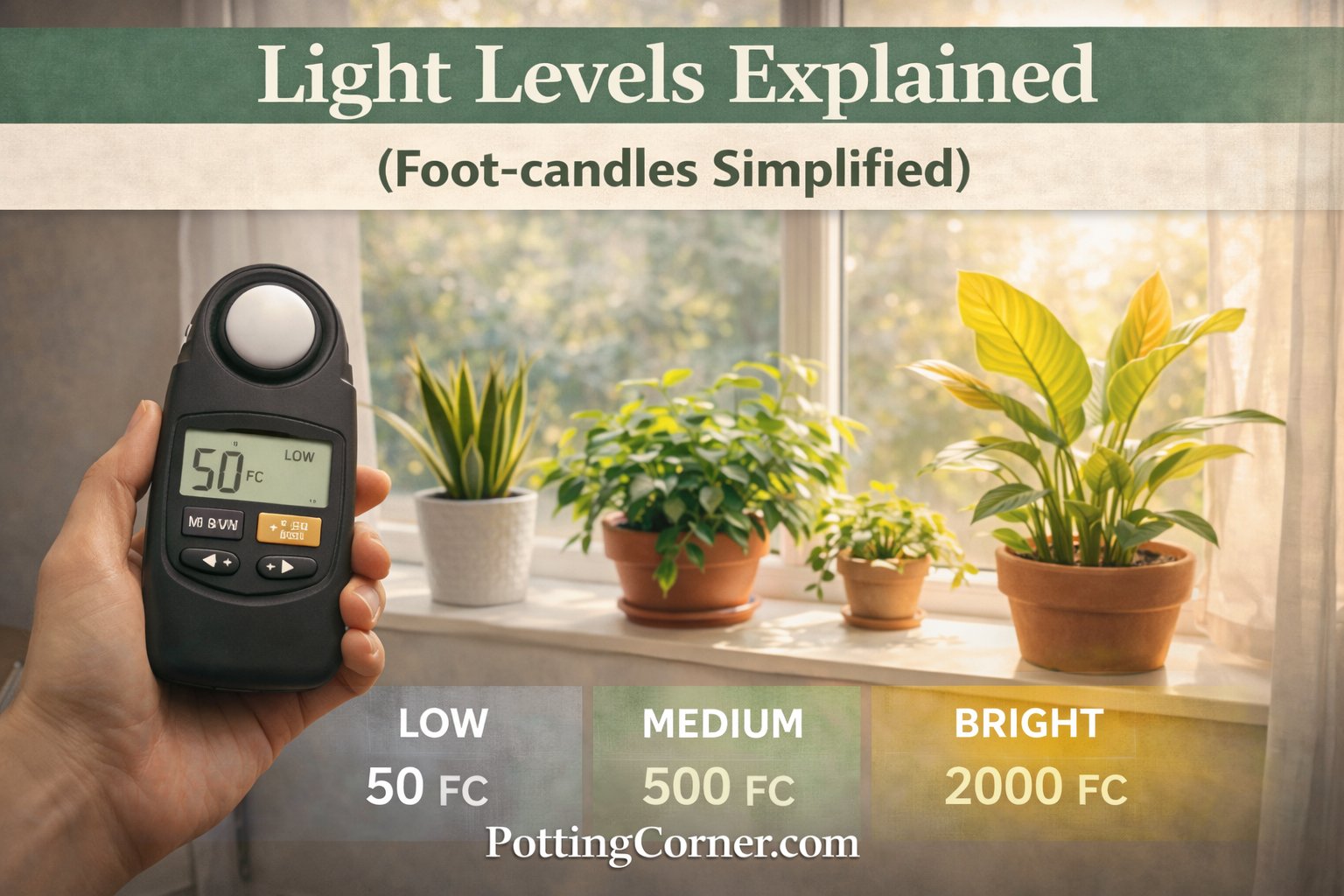
"Bright indirect light" is subjective. What looks bright to you might be dim for a fiddle leaf fig. Foot-candles (fc) and lux offer objective measurements, removing the guesswork from plant placement. A $15 light meter or free smartphone app can tell you exactly what your plant receives and whether it's enough.
For comprehensive light guidance, see Indoor Plant Light Guide.
The Direct Answer: Light Levels in Numbers
| Light Category | Foot-candles | Lux | Examples |
|---|---|---|---|
| Low light | 50-150 fc | 500-1,500 | North window, interior rooms |
| Medium light | 150-500 fc | 1,500-5,000 | East window, bright room interior |
| Bright indirect | 500-1,000 fc | 5,000-10,000 | Near south/west window, no direct sun |
| Direct sun | 1,000-5,000+ fc | 10,000-50,000+ | In direct sunbeams |
The rule: Most houseplants thrive between 200-1,000 foot-candles. Below 50 fc, even "low-light" plants struggle.
Understanding Foot-candles and Lux
What They Measure
Both measure light intensity at a surface:
- Foot-candle (fc): Light from one candle, one foot away
- Lux: Metric equivalent (1 fc ≈ 10.76 lux)
- Both measure what actually reaches your plant
- More useful than wattage or lumens
Why This Matters
Light drops rapidly with distance:
- Right at window: 500-5,000+ fc
- 3 feet back: 200-400 fc
- 6 feet back: 50-100 fc
- 10 feet back: 25-50 fc
Your "bright room" may be quite dim just a few feet from windows.
The Human Eye Deceives
Our eyes adjust automatically:
- A room feels "bright" even at 100 fc
- Plants need more than we perceive
- Only measurement gives true values
- Don't trust your impression
How to Measure Light
Using a Light Meter
Dedicated meters ($15-50):
- Turn on meter
- Hold at plant level, facing up
- Read the fc or lux value
- Measure at different times of day
- Average gives true light level
Using a Smartphone App
Free apps with reasonable accuracy:
- Search "light meter" in app store
- Open camera or use phone's light sensor
- Point at where plant sits
- Compare readings to requirements
- May be ±20% off but useful for comparison
Taking Meaningful Measurements
For accurate readings:
- Measure at plant height
- Check morning, midday and afternoon
- Note sunny vs. cloudy days
- Measure closest leaf not pot
- Average multiple readings
Seasonal Variation
Light changes through the year:
- Summer: Higher intensity, longer days
- Winter: Lower intensity, shorter days
- Spring/fall: Moderate
- Measure each season for accuracy
Matching Plants to Light Levels
Low Light: 50-150 fc
Plants that survive (not thrive) here:
- Snake plants
- ZZ plants
- Pothos
- Cast iron plants
- Chinese evergreens
These tolerate low light but grow slowly. Below 50 fc they decline.
See Low Light Indoor Plants: What "Low Light" Really Means.
Medium Light: 150-500 fc
The sweet spot for many houseplants:
- Most philodendrons
- Pothos (grow well here)
- Peace lilies
- Ferns
- Calatheas
Bright Indirect: 500-1,000 fc
Ideal for tropical houseplants:
- Monstera
- Fiddle leaf figs
- Rubber plants
- Bird of paradise
- Most variegated plants
Direct Sun: 1,000+ fc
Sun-loving plants only:
- Cacti
- Most succulents
- Citrus
- Herbs
- Desert plants
Many houseplants burn at these levels.
Common Light Scenarios
Right at South Window
Peak intensity:
- Direct sun: 2,000-5,000+ fc
- Too intense for most tropicals
- Perfect for cacti and succulents
- Filter with sheer curtain for others
3 Feet from South Window
Good for many plants:
- 300-800 fc typical
- Bright indirect range
- Works for most houseplants
- Monitor for stress signs
East Window
Gentler light:
- Morning sun: 500-1,000 fc
- Afternoon indirect: 100-300 fc
- Ideal for ferns, calatheas
- Works for most tropicals
North Window
Lowest light:
- 50-200 fc typical
- Low-light plants only
- Consider grow lights
- Measure to confirm
Center of Room
Often too dim:
- 10-50 fc typical
- Below most plant thresholds
- Needs supplemental lighting
- Only very tolerant plants survive
Grow Lights and Foot-candles
Why Grow Lights Help
Supplement natural light:
- Add measurable fc to any spot
- Extend light hours
- Consistent regardless of weather
- Enable plants in dark corners
See Grow Lights for Houseplants: A Simple Guide.
Measuring Grow Light Output
Position matters:
- Measure at plant level
- Check manufacturer's specs
- Closer = more intense
- Spread may be narrow
Combining with Natural Light
Add readings together:
- Natural light: 100 fc
- Grow light adds: 200 fc
- Total: 300 fc
- Now suitable for medium-light plants
Light Duration Matters Too
Daily Light Integral (DLI)
Total light over the day:
- Intensity × hours = total light
- 6 hours at 500 fc = 3 hours at 1,000 fc
- Plants need minimum daily totals
- Duration compensates somewhat for intensity
Most Houseplants Need
Standard requirements:
- 8-12 hours of adequate light
- Some rest in darkness
- Consistent daily patterns
- Avoid 24-hour lighting
Winter Considerations
Shorter days compound problems:
- Less intense light
- Fewer hours of light
- May need supplemental lighting
- Growth naturally slows
Common Mistakes
Trusting Room Brightness
Human perception is misleading:
- Eyes adjust; plants can't
- "Bright" rooms may be 50-100 fc
- Only measurement tells truth
- Test don't guess
Ignoring Distance Drop-off
Light fades fast:
- Each foot back = significantly less light
- Center of room vastly dimmer than window
- Place plants closer to windows
- Measure to confirm
Not Accounting for Obstructions
Things block light:
- Curtains cut 20-50%
- Overhangs block direct sun
- Trees shade seasonally
- Buildings create shadows
Assuming All Windows Equal
Direction matters enormously:
- South: Most light
- East/West: Moderate
- North: Least light
- Same room, different light
See Window Direction Guide (North/South/East/West).
Troubleshooting Light Issues
Signs of Too Little Light
Plants tell you:
- Leggy, stretched growth
- Pale or yellowing leaves
- Slow or no growth
- Variegation fading
See Why Is My Plant Not Growing?.
Signs of Too Much Light
Opposite problems:
- Bleached or faded leaves
- Brown, crispy patches
- Wilting despite water
- Leaves curling away from light
See How to Tell If Your Plant Is Getting Too Much Sun.
Adjusting Placement
Use measurements to guide moves:
- Too low: Move closer to window
- Too high: Move back or filter
- Target the range for your plant
- Remeasure after moving
Frequently Asked Questions
Do I really need a light meter?
Not strictly but it removes guesswork. A $15 meter or free app gives you objective data instead of subjective impressions.
How often should I measure light?
Once per season is good. Light changes with sun angle, tree coverage and weather patterns. Check after any changes to your space.
My plant tag says "medium light." What's that in foot-candles?
Generally 150-500 fc. But "medium" varies by source. Better to research your specific plant's needs.
Can I convert between foot-candles and lux?
Yes, multiply fc by 10.76 to get lux, or divide lux by 10.76 for fc. Most apps show both.
Is more light always better?
No. Each plant has a range. Too much light damages leaves just as too little weakens growth. Match light to plant requirements.