Watering Schedule Myths (and What to Do Instead)
"Water every Sunday." "Give it a cup of water." "Mist daily." Common watering advice is often wrong. Here's what actually matters and it's not your calendar.
Potting Corner Team · Feb 11, 2026 · 9 min read
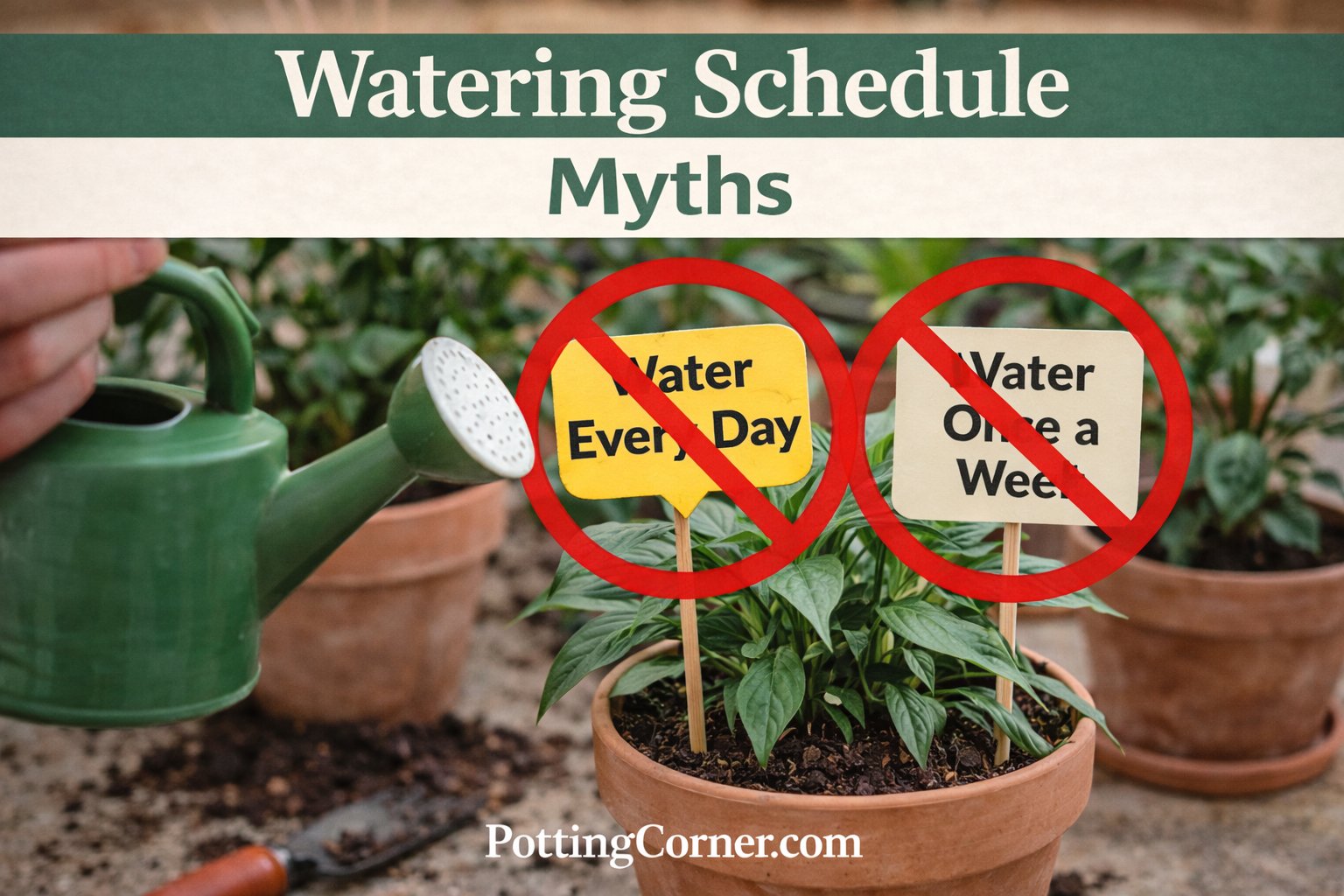
Plants don't know what day it is. They don't care that you watered last Sunday or that your app says it's time. What matters is soil moisture, light, temperature and the individual plant's needs, factors that change constantly. Fixed watering schedules feel organized but they ignore everything that actually determines when your plant needs water.
This guide debunks the most common watering myths and explains what to do instead. For comprehensive watering guidance, see How to Water Houseplants.
The Direct Answer: Schedules Don't Work
| The Myth | The Reality |
|---|---|
| "Water every X days" | Drying time varies constantly |
| "Give it a cup of water" | Volume needs vary by pot size |
| "Mist daily for humidity" | Misting doesn't really hydrate plants |
| "Wilting means it needs water" | Wilting can mean overwatering too |
| "Ice cubes are perfect" | Cold water shocks roots |
| "Rocks in bottom help drainage" | They make drainage worse |
The rule: Check soil before watering. Every time.
Myth 1: "Water Every [Day/Week/Etc.]"
The appeal is obvious it's simple, predictable and fits into a routine. But plants don't run on calendars.
Why Fixed Schedules Fail
Your plant's water needs change based on:
- Season: Summer plants drink more than winter dormant plants
- Light: More light = more photosynthesis = more water use
- Temperature: Warmer = faster evaporation
- Humidity: Dry air = faster soil drying
- Pot size: Small pots dry faster
- Pot material: Terracotta dries faster than plastic
- Root health: Damaged roots absorb poorly
A plant needing water every 5 days in July might go 2 weeks in January. A schedule ignores all of this.
What to Do Instead
Check before watering:
- Insert finger 1-2 inches into soil
- If dry at that depth, water
- If moist, wait and check again later
- Adjust checking frequency based on season
This takes seconds and actually tells you whether the plant needs water.
See How to Know When a Plant Needs Water for detailed methods.
Myth 2: "Give It a Cup of Water"
Plant care labels and well-meaning friends often suggest specific volumes: "Give it half a cup twice a week."
Why Volume Prescriptions Fail
- A 4-inch pot and a 12-inch pot need vastly different amounts
- Volume doesn't account for drainage
- Half a cup might barely wet the surface of a large pot
- Or it might waterlog a tiny one
What to Do Instead
Water until drainage:
- Water slowly over the soil surface
- Continue until water runs from drainage holes
- Stop when you see steady drainage
- Let excess drain completely
The pot size determines how much water this takes, you don't need to measure.
Myth 3: "Misting Daily Keeps Plants Hydrated"
Misting creates a fine spray of water on leaves. Many people believe this hydrates plants.
Why Misting Doesn't Hydrate
- Plants absorb water primarily through roots not leaves
- Mist evaporates in 10-30 minutes
- The humidity boost is temporary
- Soil moisture, which roots access, is unaffected
What Misting Actually Does
- Briefly raises humidity around leaves
- Wets leaf surfaces (can cause problems for some plants)
- Does NOT replace watering
What to Do Instead
For hydration: Water the soil properly
For humidity: Use a humidifier, pebble tray, or group plants together
See for when misting actually helps.
Myth 4: "Wilting Means It Needs Water"
Wilting seems like the obvious sign of thirst. But it's not that simple.
Why Wilting Is Misleading
Plants wilt when they can't get water to their leaves. This happens when:
- Soil is dry: The obvious cause, water is needed
- Roots are rotted: Damaged roots can't absorb water even if soil is wet
- Temperature shock: Cold drafts can cause temporary wilting
- Recent repotting: Disturbed roots struggle temporarily
Wilting with wet soil often means overwatering has damaged roots the opposite problem from what you'd assume.
What to Do Instead
Always check soil before acting:
- If dry → water normally
- If wet and plant is wilting → stop watering, check roots for rot
- If moist → wait and observe
Never assume wilting means "add water." It means "something is wrong with water uptake."
See Why Is My Houseplant Wilting? for diagnosis.
Myth 5: "Ice Cubes Are Perfect for Watering"
This "hack" suggests placing ice cubes on soil for slow, measured watering.
Why Ice Cubes Are Bad
- Cold shocks roots: Tropical plants especially suffer from cold
- Volume is inadequate: A few ice cubes can't properly water most plants
- Slow melting creates uneven distribution: One spot gets wet, rest stays dry
- Doesn't allow thorough drainage watering: Never fully saturates root zone
What to Do Instead
Use room-temperature water:
- Fill a watering can and let it sit to reach room temperature
- Water thoroughly until it drains
- Your plant gets adequate, even hydration without cold shock
Myth 6: "Rocks in the Bottom Help Drainage"
One of the most persistent myths: a layer of gravel or rocks at the bottom of a pot improves drainage.
Why the Rock Layer Makes Things Worse
This myth ignores basic soil physics. Water moves through soil and stops at the boundary between fine particles (soil) and coarse particles (rocks). This creates a "perched water table"—a zone of saturated soil right above the rocks.
The result:
- Soil above rocks stays wetter longer
- Effective soil depth is reduced
- Roots have less space
- Drainage is actually worse
What to Do Instead
Use pots with drainage holes. That's the only reliable drainage solution.
If you want to prevent soil from washing through holes, use a small piece of mesh or coffee filter not a layer of rocks.
See Drainage Holes: Why They Matter.
Myth 7: "Water Less in Winter"
This one is half-right but often misunderstood.
The Nuance
Plants do typically need less water in winter because:
- Lower light means less photosynthesis
- Dormancy reduces water uptake
- Cooler temperatures slow evaporation (sometimes)
But "water less" is interpreted as "give less water at each watering"—which is wrong.
What to Do Instead
Water less frequently not less thoroughly:
- Check soil before watering (as always)
- When watering, still water until drainage
- Expect longer intervals between waterings
- Don't reduce the amount per watering, reduce the frequency
The plant still needs thorough watering when it needs water. It just needs water less often in winter.
Myth 8: "All Plants Need the Same Care"
Plant care generalizations treat all houseplants alike. But a cactus and a fern have opposite needs.
Why One-Size-Fits-All Fails
- Succulents need complete drying; ferns want consistent moisture
- Low-light plants use less water; bright-light plants use more
- Some plants tolerate neglect; others are demanding
Following generic advice means either overwatering drought-tolerant plants or underwatering moisture-lovers.
What to Do Instead
Learn your specific plant's needs:
- Research the species
- Understand its natural habitat
- Adjust watering to match
- Observe and adapt to your conditions
A pothos and a cactus should never be on the same watering routine.
Myth 9: "Yellow Leaves Mean Underwatering"
Yellow leaves are often blamed on lack of water. Sometimes that's right, often it's not.
Why Yellow Leaves Are Complicated
Yellow leaves can indicate:
- Overwatering: More common than underwatering
- Underwatering: Possible but other signs usually appear first
- Nutrient deficiency: Especially nitrogen
- Natural aging: Older leaves yellow and drop normally
- Light issues: Too much or too little
- Pest problems: Sap-sucking insects cause yellowing
What to Do Instead
Diagnose don't assume:
- Check soil moisture first
- Consider recent care changes
- Look for other symptoms (spots, pests, etc.)
- Yellow + wet soil = likely overwatering
- Yellow + very dry soil = possible underwatering
See Why Are My Houseplant Leaves Turning Yellow? for diagnosis.
Myth 10: "More Water = Faster Growth"
Some assume that more water encourages growth, like pressing the accelerator.
Why More Water Doesn't Help
Plants take what they need:
- Excess water doesn't speed photosynthesis
- It just sits in soil, reducing oxygen
- Overwatering leads to root rot not faster growth
- Growth depends on light, nutrients and genetics not water volume
What to Do Instead
Water appropriately, no more:
- Provide what the plant needs
- Optimize light for growth
- Fertilize during growing season
- Accept the plant's natural growth rate
Drowning a plant doesn't make it grow faster it makes it die slowly.
What Actually Works
The Finger Test
Insert your finger 1-2 inches into soil:
- Dry? Water.
- Moist? Wait.
This simple check replaces all schedules.
The Lift Test
Learn what "watered" and "dry" feel like when you lift a pot. A dry pot weighs noticeably less than a watered one.
Observation
Watch your plant. Note how long it takes to dry. Adjust based on seasons. Learn the rhythm but stay flexible.
Understanding Your Environment
Know your conditions:
- Light level
- Temperature range
- Humidity
- Pot materials
These determine watering needs more than any schedule.
Frequently Asked Questions
Aren't schedules easier than checking every plant?
Checking takes 5 seconds per plant. Once you learn your plants' patterns, you'll naturally know when to check more closely. The alternative, dead plants from schedule-following, isn't easier.
My plant came with watering instructions. Are those wrong?
They're generalizations. "Water weekly" is a rough starting point not gospel. Check soil and adjust based on your actual conditions.
What if I want a reminder system?
A reminder to "check if plants need water" is reasonable. A reminder to "water plants" regardless of need is risky.
How do I know which myths apply to my situation?
If someone gives you advice that ignores your specific conditions, schedule-based, volume-based, or one-size-fits-all it's probably a myth. Soil checking works universally.