Mealybugs on Houseplants: How to Identify and Get Rid of Them
White cottony clumps in the leaf joints are usually mealybugs. Confirm them with a quick squash test, dab them with rubbing alcohol, then treat weekly until you've gone several weeks without finding a single one.
Potting Corner Team · Sep 29, 2026 · Updated Sep 29, 2026 · 9 min read
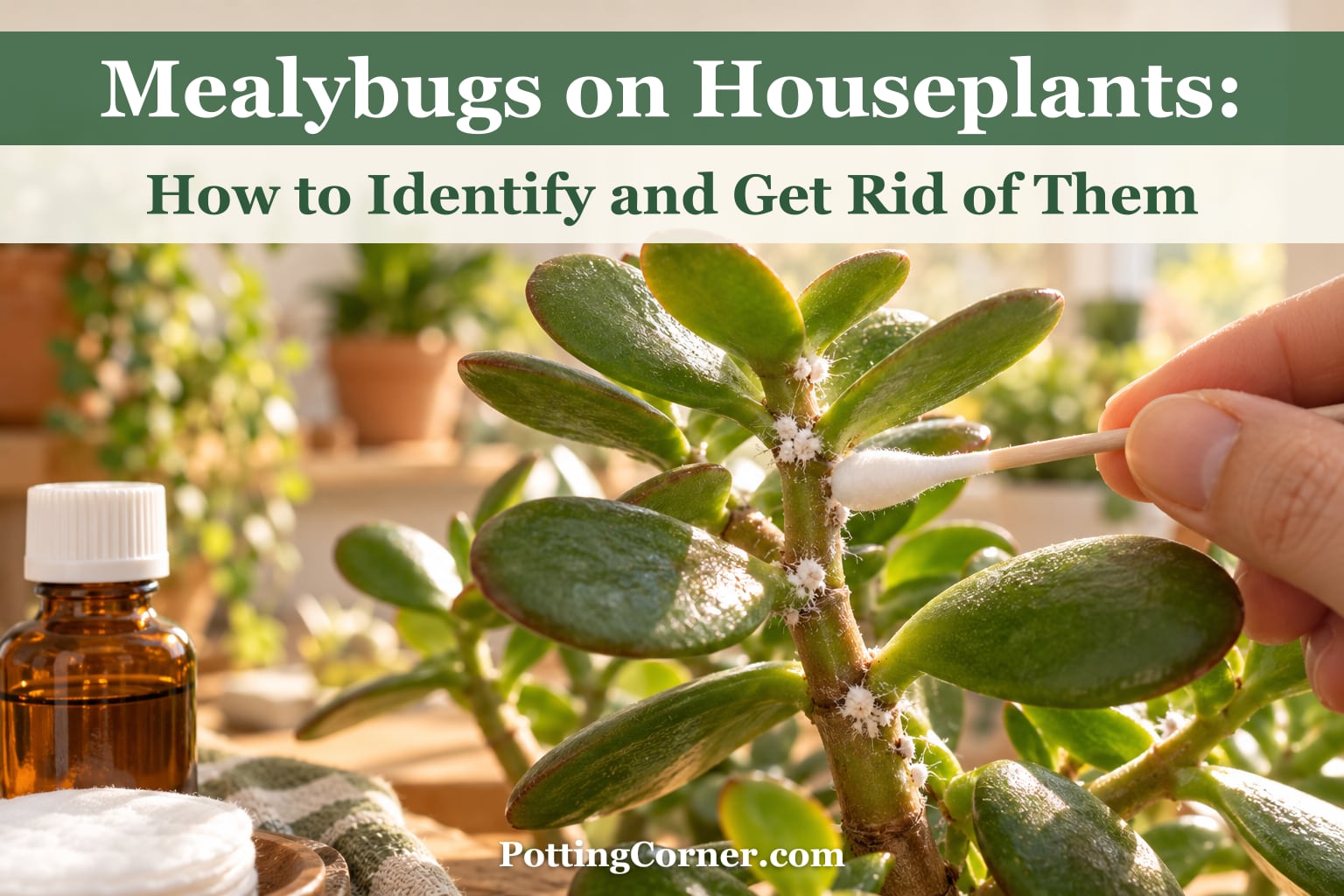
Short answer: white, cottony or fluffy clumps tucked into the leaf joints and undersides of a houseplant are almost always mealybugs, small soft insects covered in wax that suck sap. To get rid of them, isolate the plant, dab every visible clump with a cotton swab dipped in 70% (or weaker) rubbing alcohol, rinse the plant, then spray insecticidal soap or horticultural oil. Repeat every 7 days and keep going until you find none for several weeks in a row, usually 4-6 weeks or more. Mealybugs are persistent, so one round never finishes the job.
Plant Doctor
Not sure it's mealybugs? Upload a photo and answer 3 quick questions.
For a broader overview of plant problems, see Houseplant Troubleshooting: Common Problems and Fixes.
The Direct Answer: Is It Mealybugs?
| Sign | Mealybugs | Probably something else |
|---|---|---|
| Where the white stuff is | Raised cottony clumps in leaf joints, sheaths, undersides | Flat film across the whole upper leaf |
| Squash test | Squashes into a wet smear | Crumbles like powder or grit |
| Close-up | Oval, segmented body with waxy threads at the edges | No body, or a hard fixed bump |
| Leaves | Often sticky | Not sticky |
| Movement | Crawl slowly, never fly | Fly up when disturbed |
The rule: if the white fluff squashes into a wet smear, it's a living insect, and you should start treatment this week.
What Do Mealybugs Look Like?
The insects
- Flattened, oval, soft bodies up to about 4 mm long (RHS), covered in white powdery or cottony wax
- Waxy filaments project from the edges of the body (RHS); longtailed mealybugs have two long tails
- Citrus mealybug, the most common species on foliage, is pink under the white wax (UW-Madison)
- They move sluggishly and cannot fly
Eggs and young
- Cottony egg sacs contain tiny yellow eggs. UC IPM says a female lays 100-200 or more eggs over 10-20 days; UW-Madison puts citrus mealybug at up to 600
- Newly hatched young, called crawlers, are yellow to orange or pink, lack wax and are quite mobile (UC IPM)
- Longtailed mealybugs skip the egg sac and produce live young (UW-Madison)
Where they hide
The RHS describes mealybugs living in clusters in hard-to-reach spots: leaf axils, leaf sheaths, between twining stems and under loose bark. Also check leaf undersides and the rim of the pot.
Damage
- Sticky honeydew on leaves, sometimes with black sooty mold growing on it
- Ants visiting the plant (UC IPM notes ants protect mealybugs from natural enemies)
- Yellowing, stunted or distorted growth and leaf drop in heavy infestations
Mealybugs are common on hoyas, succulents, cacti, phalaenopsis orchids, African violets, jade plants, dracaena, fiddle leaf figs and string of pearls. The RHS names cacti, succulents and orchids among common hosts.
How to Confirm It's Mealybugs (Not Scale, Mildew or Salt Crust)
The squash test
- Press a white clump with a cotton swab or tissue
- A living mealybug squashes into a wet smear, often pinkish or orange
- Dry powder or gritty crust with no smear points away from mealybugs
Smear color varies by species, so treat any wet smear as a positive.
Mealybugs vs. look-alikes
| Problem | What you see | How to tell it from mealybugs |
|---|---|---|
| Mealybugs | Soft, fuzzy white clumps in leaf joints | Squash wet; crawl slowly |
| Scale insects | Small immobile brown, tan or white bumps along stems and veins | Hard or waxy shells that flick off with a fingernail and never move. Some scale egg masses are cottony, so look for a bump next to the fluff |
| Root mealybugs | Plant declining with nothing visible on leaves | White waxy patches on roots and inside the pot. Unpot to check |
| Powdery mildew | Flat, dusty white film on upper leaf surfaces | Wipes off with no bodies underneath |
| Whiteflies | Tiny white insects | Fly up in a cloud when the plant is moved; mealybugs can't fly |
| Aphids | Small soft insects on shoot tips | Mostly bare and colored; tube-like cornicles at the rear. Some woolly aphids look waxy |
| Fertilizer/salt crust | White crust on soil, pot rim or leaves | Hard and gritty, doesn't smear |
Why Mealybugs Are So Hard to Get Rid Of
- Wax protection. UC IPM notes the waxy coating of adults makes contact insecticides less effective
- Hiding places. UW-Madison says immature mealybugs hide in hard-to-reach spots, which is why they're difficult to eliminate
- Constant hatching. Iowa State advises frequent applications because insecticides work best on immature mealybugs, which keep hatching
- Indoor warmth. They stay active year-round indoors, just more slowly in winter
- New plants. Most infestations start with a plant brought home without inspection
How to Get Rid of Mealybugs: Treatment Schedule
Soaps and oils work best on young, less-waxy crawlers, and new crawlers keep emerging from egg sacs. That's why the schedule repeats weekly instead of relying on one heavy treatment.
Day 0: Isolate, prune, dab and rinse
- Move the plant away from others and check every neighbor: leaf joints, sheaths and pot rims
- Cut off heavily infested stems or leaves and bag them
- Dab every visible mealybug and egg sac with a cotton swab dipped in rubbing alcohol, 70% isopropyl or weaker (UC IPM). Test on one leaf first and check it the next day
- Rinse the plant with a lukewarm spray to wash off loose wax, crawlers and honeydew. UW-Madison notes a moderately strong spray of warm water dislodges most mealybugs
Day 1: Spray soap or oil
Spray an insecticidal soap, horticultural oil or neem-based product labeled for houseplants. Work it into leaf joints and undersides, where colonies hide.
Day 7: Check the roots
Unpot the plant and look at the root ball and inside of the pot. White waxy patches or slow-moving white insects on roots mean root mealybugs, which UW-Madison calls particularly difficult to control. Foliar and root mealybugs can occur together. For unpotting technique, see How to Repot Houseplants: The Complete Guide.
Every 7 days: Inspect, dab, spray
Repeat the inspection, alcohol dabbing and soap/oil spray weekly. UC IPM advises continuing weekly until they're gone. A practical stopping point is 3 consecutive weeks without finding any, which usually takes 4-6 weeks or more.
Day 28 onward: If they keep coming back
- A systemic houseplant insecticide (for example imidacloprid spikes or granules, per UC IPM) watered into the soil is a last resort
- Or discard the plant. The RHS notes it can be simpler to dispose of heavily affected plants than to try to eliminate mealybugs
Safety Notes (Plants, Pets and People)
- Least-toxic first. Pruning, alcohol dabbing and water rinses before soap or oil, and soap or oil before anything systemic
- Rubbing alcohol should be 70% isopropyl or weaker. Test one leaf first. It's flammable, so keep it away from open flames
- Soap-sensitive plants. Clemson lists ornamental ivy, maidenhair fern, dieffenbachia, schefflera, crown of thorns, chrysanthemum, lilies (Easter lilies during bud formation, Asiatic and oriental lilies), jade plant, begonia, fuchsia, zebra plant, impatiens and certain palms among plants that insecticidal soap can injure. Test first; Clemson notes injury may take at least 48 hours to show
- Labels. Only use products labeled for indoor houseplants. Spray outdoors or in a ventilated spot if possible, and let the plant dry before bringing it back
- Systemic insecticides: keep away from children and pets, follow the label exactly, and don't use them on plants that go outdoors to flower, since neonicotinoids harm bees and other pollinators. They can also trigger spider mite outbreaks
What Progress Looks Like
| Day | What you should see |
|---|---|
| Day 3 | Visible colonies removed; a few survivors or crawlers may appear in hidden spots |
| Day 7 | Fewer new clumps. New ones may appear as eggs hatch. Keep treating |
| Day 14 | Only an occasional single mealybug; no fresh honeydew |
| Day 28 | None found at weekly checks for 2-3 weeks. Keep inspecting every time you water for another 1-2 months, since reinfestation is common |
When to Give Up on the Plant
Discard heavily infested plants, especially inexpensive or common ones, to protect the rest of your collection. For a valuable plant, take cuttings from clean stems after inspecting them closely. If mealybugs are still turning up after 6-8 weeks of consistent treatment, discarding is reasonable. For root mealybugs, UW-Madison calls discarding heavily infested plants the most practical option.
How to Prevent Mealybugs
- Inspect every new plant: leaf axils, undersides and roots. Clemson recommends isolating new plants for six weeks
- Check plants each time you water, especially hoyas, succulents and orchids
- Control ants that visit your plants
- Remove dead leaves and debris where mealybugs can hide
Frequently Asked Questions
Can mealybugs spread to other plants?
Yes. Crawlers are mobile, which is why you isolate the plant and check its neighbors on day 0.
Why do mealybugs come back after I wiped them off?
Egg sacs and crawlers hidden in leaf joints, sheaths or roots survive. Weekly treatment catches each new batch of crawlers before they mature.
Are the white bugs in my succulent's soil mealybugs?
Possibly root mealybugs. If they jump, they're more likely springtails, which are usually harmless.
Plant Doctor
White fluff but not sure what it is? Upload a photo and answer 3 quick questions.
Related Guides
- Houseplant Troubleshooting: Common Problems and Fixes
- Yellow Leaves on Houseplants: What's Wrong
- Spider Mites on Houseplants: How to Spot and Get Rid of Them
- How to Repot Houseplants: The Complete Guide
- How to Water Succulents Indoors
Sources
- Pest Notes: Mealybugs, UC Statewide IPM Program, University of California
- Mealybug (glasshouse), Royal Horticultural Society
- Mealybugs, University of Wisconsin-Madison Division of Extension
- Mealybugs on Indoor Plants, University of Maryland Extension
- Common Houseplant Insects & Related Pests, Clemson Cooperative Extension
- Diagnosing Houseplant Problems Caused by Insect Pests, Iowa State University Extension and Outreach
- Indoor plants: sap-feeding insects, Royal Horticultural Society
- Pest Notes: Scale Insects, UC Statewide IPM Program, University of California