Spider Mites on Houseplants: How to Spot, Confirm and Get Rid of Them
Fine webbing, pale pin-prick speckles and a dusty, faded look usually mean spider mites. Confirm them with a 10-second paper tap test, then rinse and spray on a 5-7 day schedule for at least 4 weeks to break their life cycle.
Potting Corner Team · Sep 29, 2026 · Updated Sep 29, 2026 · 10 min read
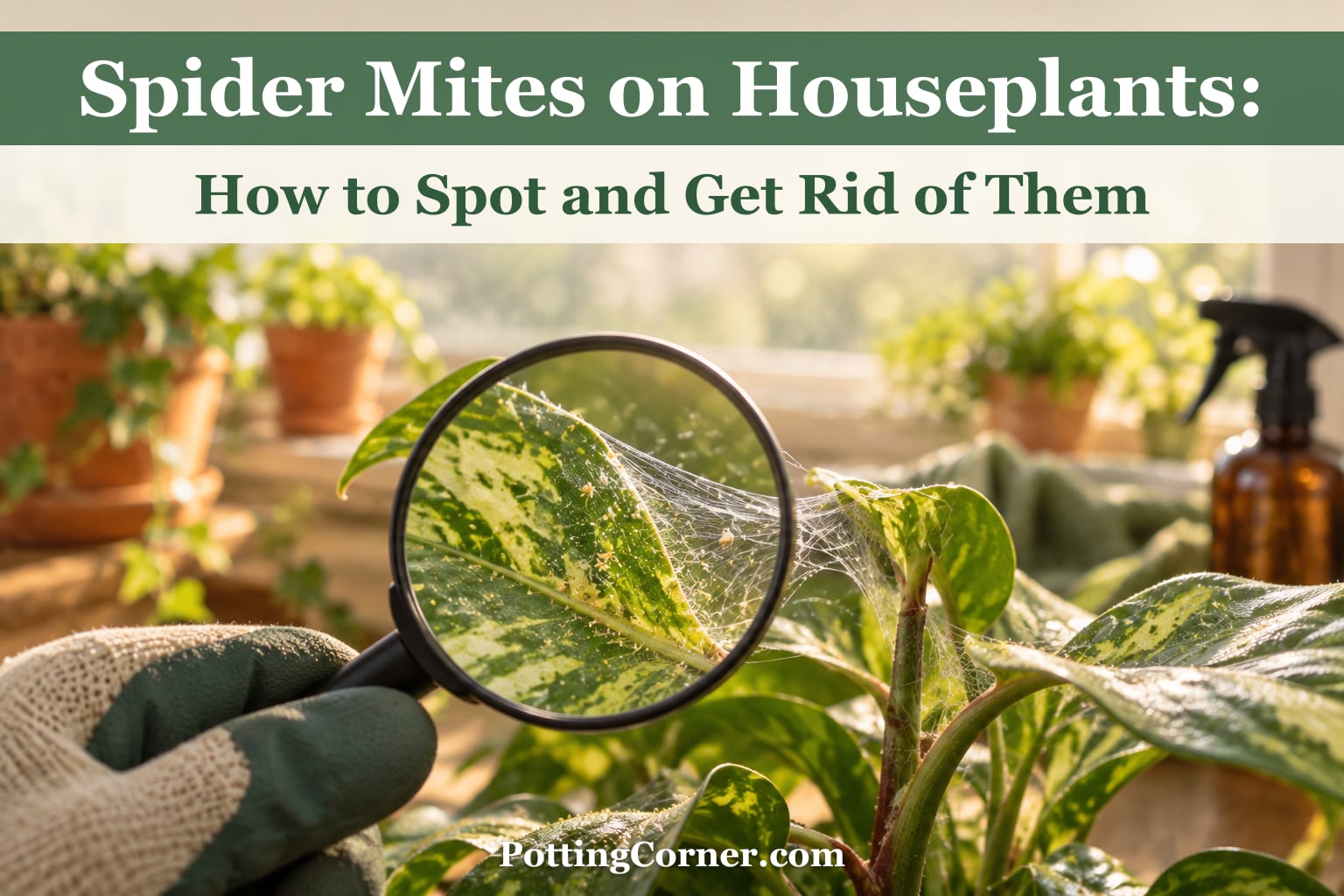
Short answer: if your houseplant has tiny pale speckles on the leaves, a dull or dusty look and, in bad cases, fine silky webbing at the shoot tips, you are most likely dealing with spider mites. Confirm it by tapping a leaf over white paper and watching for specks that walk. To get rid of them, isolate the plant, rinse it hard in the shower, then spray insecticidal soap or horticultural oil on both leaf surfaces every 5-7 days for at least 4 weeks. One treatment is never enough, because eggs keep hatching.
Plant Doctor
Not sure it's spider mites? Upload a photo and answer 3 quick questions.
For a broader overview of plant problems, see Houseplant Troubleshooting: Common Problems and Fixes.
The Direct Answer: Spider Mite Checklist
| What to check | Spider mites | Probably something else |
|---|---|---|
| Paper tap test | Tiny specks start walking | Nothing moves |
| Webbing | Fine silk between leaves and stalks | No silk, or a single large spider web |
| Upper leaf surface | Many tiny pale dots (stippling) | Solid patches, crispy tips only |
| Stickiness | Not sticky | Sticky leaves point to sap-sucking insects |
| Location | Warm, dry room, near a heater | Cool, humid spot |
The rule: stippling plus moving specks on the tap test is enough to start treatment. Don't wait for webbing, which only shows up in heavier infestations.
What Do Spider Mites Look Like on a Plant?
Spider mites are not insects. They are eight-legged relatives of spiders, and they are small enough that the damage is usually the first thing you notice (Clemson Extension).
The mites themselves
- Adult females are less than 1/20 inch long, with an oval body (UC IPM)
- Usually yellowish-green with two dark patches, turning red-orange in autumn or when stressed
- They live mainly on leaf undersides, so that's where to look
- A phone camera zoomed in, or a hand lens, will show them moving slowly
Eggs and webbing
- Eggs are round and translucent, "like tiny droplets," turning cream before they hatch (UC IPM)
- White cast skins collect on leaf undersides
- Webbing is fine and silky, strung between leaves, leaf stalks and stems, usually thickest at shoot tips
What the damage looks like
- Many tiny pale dots across the upper leaf surface, called stippling
- Leaves turn dull, grey, bronzed or yellow, then drop early
- The whole plant looks faded or dusty
- Leaf undersides can feel slightly gritty
Iowa State Extension describes the progression as a mottled appearance, with the yellow-green mottling turning tan before the leaves fall off.
How to Confirm It's Spider Mites (Not Thrips, Dry Air or Mildew)
The white-paper tap test
- Hold a sheet of white paper under a leaf
- Tap the leaf sharply a few times
- Wait a few seconds and watch the paper
- Specks that start to crawl are mites. Dust and debris stay still
UC IPM and Iowa State both recommend this method. It's quick enough to repeat before every treatment, and it's the best way to track progress.
Spider mites vs. look-alikes
| Problem | What you see | How to tell it from spider mites |
|---|---|---|
| Spider mites | Pale stippling, fine webbing, moving round specks | Specks walk on paper; not sticky |
| Thrips | Silvery, shiny patches with tiny black dots (droppings) | No webbing; thrips are long and thin like a grain of rice and move fast |
| Broad/cyclamen mites | Twisted, cupped, stunted new growth | Invisible without strong magnification; no webbing; mature leaves look normal |
| Low humidity | Crispy brown tips and edges | No stippling across the leaf, no webbing, nothing moves on paper |
| Whiteflies | Tiny white insects fly up when the plant is moved | Leave sticky honeydew; spider mites can't fly and aren't sticky |
| Powdery mildew | White powdery coating on leaf tops | Powder wipes off; mite webbing is stringy silk over speckled leaves |
| Sunburn | Bleached or brown patches | Only on the sun-facing side; no speckled undersides, no webbing |
If the only symptom is crispy tips, start with Brown Leaf Tips: Causes and Fixes. If bleached patches appeared after a move to a sunnier window, see How to Tell If Your Plant Is Getting Too Much Sun.
Why Houseplants Get Spider Mites
Spider mites build up fast when conditions suit them:
- Warm, dry air. Heating season and spots next to radiators are classic trouble zones
- Water stress. UC IPM notes that plants under water stress are highly susceptible
- Dust. Spider mites prefer hot, dusty conditions (UC IPM)
- New plants. Mites arrive on plants brought home without quarantine
Speed matters. When temperature and food supply are favorable, a generation can be completed in less than a week (UC IPM), and mites walk or drift to nearby plants. Act within a few days of spotting them.
Commonly affected houseplants include English ivy and palms (both named by Clemson), plus calathea, alocasia, dracaena, fiddle leaf fig and cacti.
How to Get Rid of Spider Mites: Treatment Schedule
The schedule is built around the life cycle. Soaps and oils kill only the mites they touch, and eggs keep hatching, so you repeat treatment before newly hatched mites are old enough to lay eggs of their own.
Day 0: Isolate, prune and rinse
- Move the plant away from your other plants
- Tap-test the neighbors' leaves too
- Cut off the worst bronzed or heavily webbed leaves and bag them
- Cover the soil, then rinse the whole plant with a forceful lukewarm spray in the shower or sink, focusing on leaf undersides and leaf joints
- Wipe sturdy leaves with a damp soft cloth
UC IPM notes that regular, forceful spraying with water often reduces spider mite numbers on its own.
Day 1: First soap or oil spray
Once the plant is dry, spray an insecticidal soap or horticultural oil labeled for houseplants. Wet the upper and lower leaf surfaces thoroughly. Coverage is everything: UC IPM stresses that oils and soaps must contact mites to kill them, especially on leaf undersides.
Test on a few leaves first (see safety notes below).
Day 5-7 and every 5-7 days after: Repeat
- Rinse, then spray again
- Keep going for at least 4 weeks, which means 4-6 applications. Iowa State recommends weekly applications for 4 to 6 weeks
- Do a tap test before each treatment to track numbers
From Day 7: Fix the conditions
- Move the plant away from heaters
- Water consistently so the plant isn't drought-stressed
- Raise humidity around the plant.
Day 28: If mites are still there
- Consider predatory mites such as Phytoseiulus persimilis from a biocontrol supplier
- Or use a miticide labeled for houseplants
- Avoid broad-spectrum insecticides such as pyrethroids and imidacloprid. UC IPM explains that these often kill mite predators, and some can make mite outbreaks worse
Safety Notes (Plants, Pets and People)
- Least-toxic first. Water rinsing, then soap or oil, before anything stronger
- Soap-sensitive plants. Clemson lists ornamental ivy, maidenhair fern, dieffenbachia, schefflera, crown of thorns, chrysanthemum, lilies (Easter lilies during bud formation, Asiatic and oriental lilies), jade plant, begonia, fuchsia, zebra plant, impatiens and certain palms among plants that can be injured by insecticidal soap. Test a few leaves first. Clemson notes injury may take at least 48 hours to appear
- Heat. UC IPM advises against applying oils or soaps when temperatures exceed 90°F
- Labels. Only use products whose label allows indoor houseplant use. Spray outdoors or in a ventilated spot if possible, and let the plant dry before bringing it back near pets and children
- Systemic insecticides are a last resort for any houseplant pest: keep them away from children and pets, follow the label exactly, and don't use them on plants that go outdoors to flower, since neonicotinoids harm bees and other pollinators
What Progress Looks Like
| Day | What you should see |
|---|---|
| Day 3 | Webbing gone after rinsing; far fewer moving mites on the tap test. Speckled leaves won't turn green again |
| Day 7 | Few or no live mites after the second treatment. Eggs are still hatching, so continue |
| Day 14 | No new stippling on leaves that emerged after treatment began. Old damaged leaves may still yellow and drop |
| Day 28 | Tap tests clean for 2 weeks and new growth unmarked. Keep checking weekly for another month |
Judge progress by new growth and the tap test, not by the old leaves. Damaged leaves stay damaged.
When to Give Up on the Plant
If a small or inexpensive plant is covered in webbing and most leaves are bronzed, discarding it is often the safest choice for the rest of your collection. For a valued plant, cut it back hard, keep clean, healthy cuttings, and treat or discard the mother plant. Get help if mites persist after 4-6 weeks of weekly treatment.
How to Prevent Spider Mites
- Quarantine new plants. Clemson recommends isolating new plants for six weeks. Check leaf undersides with a hand lens or phone zoom
- Wash smooth-leaved plants every 2-3 weeks to remove dust and early mites
- Keep plants away from heaters and don't let them dry out repeatedly. See How to Know When a Plant Needs Water
- Tap-test susceptible plants such as ivy, palms and calathea regularly during heating season
Frequently Asked Questions
Can spider mites spread to my other plants?
Yes. They walk or drift from plant to plant, which is why isolation and checking the neighbors is the first step.
Will the speckled leaves recover?
No. Stippled or bronzed tissue won't turn green again. Success means new leaves come in clean.
Does raising humidity kill spider mites?
Not on its own. Dry air favors them, so raising humidity helps as part of the plan, but you still need rinsing and repeated soap or oil treatments.
Why are my spider mites red?
Spider mites are usually yellowish-green, but they can turn red-orange in autumn or when stressed. Color doesn't change the treatment.
Plant Doctor
Still unsure what's speckling your leaves? Upload a photo and answer 3 quick questions.
Related Guides
- Houseplant Troubleshooting: Common Problems and Fixes
- Brown Leaf Tips: Causes and Fixes
- Yellow Leaves on Houseplants: What's Wrong
- Mealybugs on Houseplants: How to Get Rid of Them
- Fungus Gnats: Causes and How to Get Rid of Them
Sources
- Pest Notes: Spider Mites, UC Statewide IPM Program, University of California
- Glasshouse red spider mite, Royal Horticultural Society
- Common Houseplant Insects & Related Pests, Clemson Cooperative Extension
- Diagnosing Houseplant Problems Caused by Insect Pests, Iowa State University Extension and Outreach
- Houseplant pests, Colorado State University
- Pest Notes: Whiteflies, UC Statewide IPM Program, University of California