Foot-Candles for Plants: Light Levels Explained (With a Chart)
How many foot-candles do houseplants need? Low light is 50-150 fc, medium 150-500, bright indirect 500-1,000, direct sun 1,000+. Here's what 5, 50, 100, 500 and 1,000 foot-candles look like in a real room and how to measure yours with a phone.
Potting Corner Team · Mar 17, 2026 · Updated Sep 15, 2026 · 11 min read
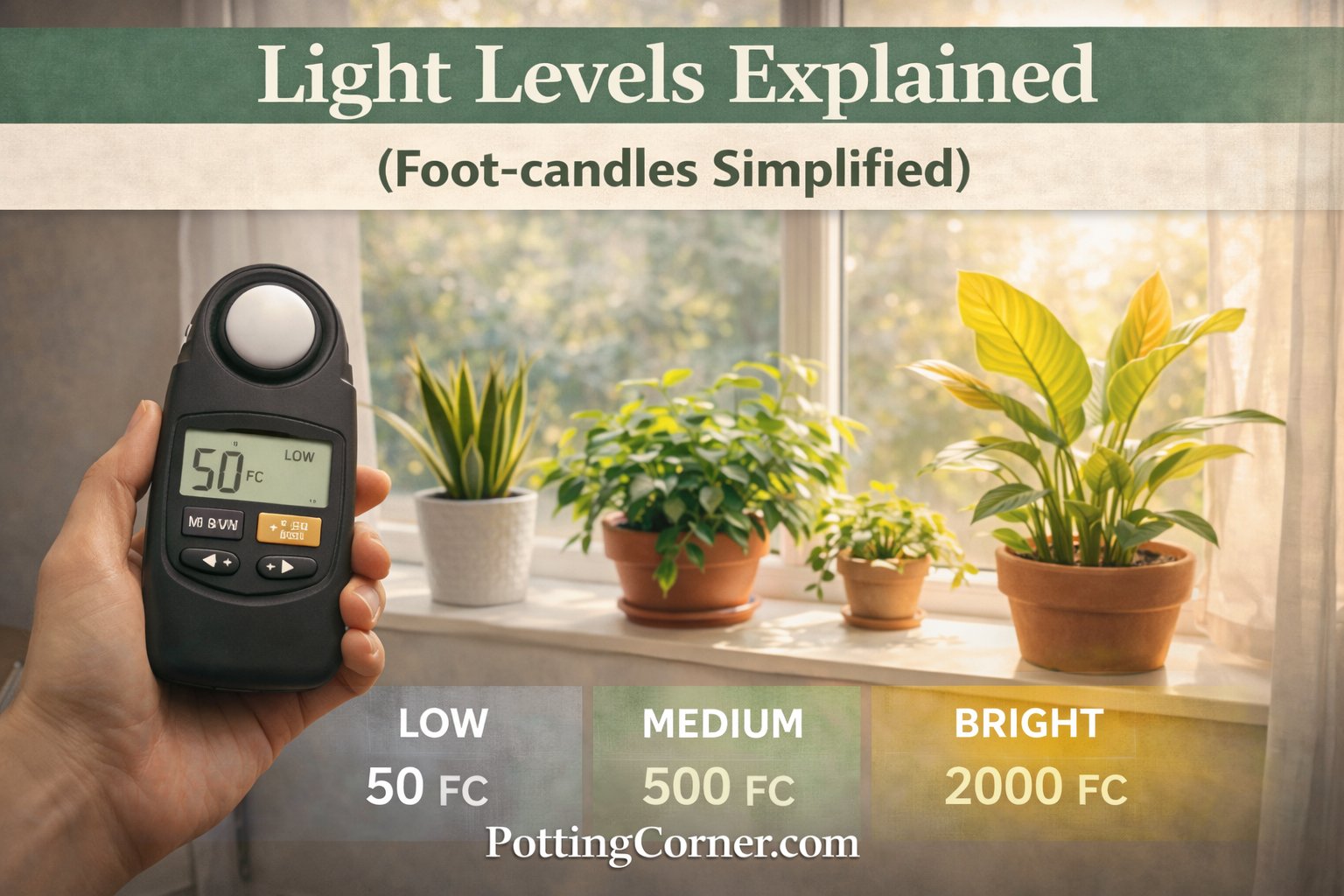
Short answer: most houseplants want 200-1,000 foot-candles (fc). "Low light" plants survive at 50-150 fc, "medium light" plants want 150-500 fc, "bright indirect light" means 500-1,000 fc, and anything above 1,000 fc is direct sun territory. Below 50 fc almost nothing grows. A typical living room away from the window measures only 50-150 fc, which is why so many plants placed "in a bright room" slowly decline.
"Bright indirect light" is a guess. A number isn't. Foot-candles (and their metric cousin, lux) tell you exactly how much light reaches a leaf, and a free phone app or a $15 meter gets you within 20% of the truth. This guide gives you the ranges, shows what each number looks like in everyday life, and explains how to measure your own spots. For where to put specific plants, see Indoor Plant Light Guide.
Foot-Candle Chart for Houseplants
| Light category | Foot-candles | Lux | Where you find it | Example plants |
|---|---|---|---|---|
| Too dark | under 50 fc | under 500 | Interior walls, hallways, 10+ ft from windows | Nothing thrives; even snake plants decline |
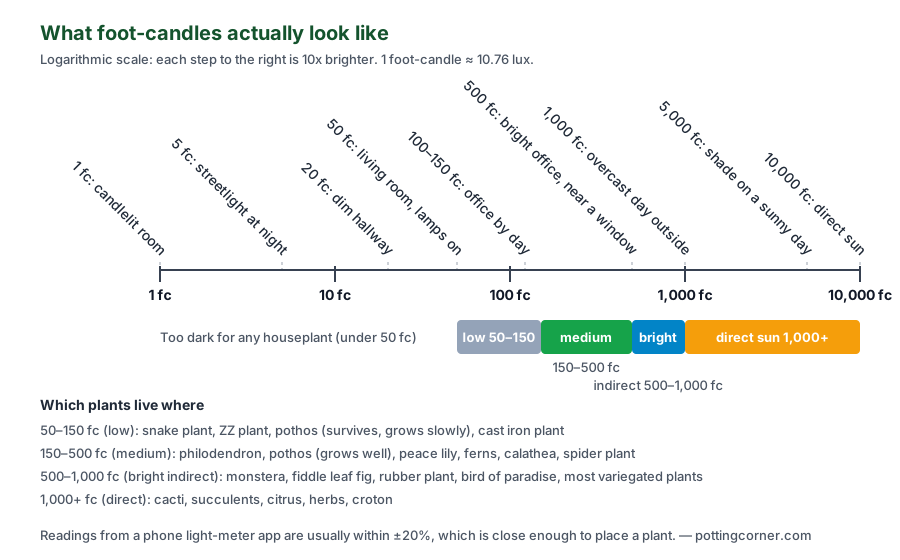
| Low light | 50-150 fc | 500-1,500 | North window, 6-10 ft from an east/west window | Snake plant, ZZ, pothos (slow), cast iron plant |
| Medium light | 150-500 fc | 1,500-5,000 | East window, 3-6 ft from a south/west window | Philodendron, peace lily, ferns, calathea, spider plant |
| Bright indirect | 500-1,000 fc | 5,000-10,000 | 1-3 ft from a south/west window, no sunbeam on the leaf | Monstera, fiddle leaf fig, rubber plant, bird of paradise |
| Direct sun | 1,000-5,000+ fc | 10,000-50,000+ | Sunbeam hitting the leaf | Cacti, succulents, citrus, herbs, croton |
Two rules to remember:
- Most houseplants are happiest between 200 and 1,000 fc.
- Your eyes lie. A room that feels bright to you is often 100 fc, which is the bottom of the "low light" band for a plant.
What Foot-Candles Look Like in Real Life
The numbers mean more once you attach them to places you know.
How bright is 5 foot-candles?
About the light under a streetlight at night, or a room lit by a single candle a few feet away. You can walk around and read large print with effort. No houseplant can live here. If a phone app reads 5 fc where your plant sits, the plant is in the dark as far as photosynthesis is concerned.
How bright is 50 foot-candles?
A living room in the evening with a couple of lamps on, or a spot 8-10 feet from a window during the day. This is the absolute floor for the toughest plants (snake plant, ZZ plant, cast iron plant), and even they will only hold on rather than grow. Pothos will survive but stretch and lose variegation.
How bright is 100 foot-candles?
A typical office or classroom by day, or a living room 6 feet from a window. Comfortable for people, dim for plants. Low-light plants do okay; anything sold as "bright indirect" will slowly weaken. If you have plants "doing fine" here, they are probably living off stored energy and will show it in a few months.
How bright is 500 foot-candles?
A bright office, a kitchen with big windows, or about 3 feet from a south window with no sunbeam on the plant. This is where most tropical houseplants start to thrive rather than survive: pothos vines quickly, philodendrons push new leaves every few weeks, peace lilies actually flower.
How bright is 1,000 foot-candles?
An overcast day outdoors, or right next to a bright window just outside the direct sunbeam. This is the top of "bright indirect light" and the bottom of "direct sun." Monstera, fiddle leaf figs and rubber plants love it. Calatheas and ferns start to scorch here if a sunbeam actually touches the leaves.
5,000 foot-candles and up
Direct sun through glass, or shade outdoors on a sunny day. Cacti, succulents, citrus and herbs want this. Most tropicals bleach and burn within days. See How to Tell If Your Plant Is Getting Too Much Sun.
How Many Foot-Candles Is Bright Indirect Light?
Bright indirect light is roughly 500-1,000 foot-candles (5,000-10,000 lux). The "indirect" part means no sunbeam is landing on the leaves; the light is bouncing in from a bright sky or reflecting off walls.
In practice you get bright indirect light:
- 1-3 feet from a south or west window, just outside the sun's path
- Directly in an east window (morning sun is gentle enough to count)
- Behind a sheer curtain on a south window (curtains cut light by 20-50%)
- Under a grow light at the distance the manufacturer specifies
If your meter reads 300 fc where you thought you had bright indirect light, you have medium light. That gap explains most "my monstera stopped growing" problems.
How Many Foot-Candles for Low-Light Plants?
"Low light" on a plant tag means 50-150 foot-candles. It does not mean no light. Snake plants, ZZ plants, pothos and cast iron plants tolerate this range, but tolerate is the right word: growth slows to a crawl, leaves get smaller, variegated plants turn green. Give the same plants 200-400 fc and they look like different plants. See Low Light Indoor Plants: What "Low Light" Really Means.
Why Light Drops So Fast Away From the Window
Light intensity falls off steeply with distance. A spot that reads 1,000 fc at the glass can read 100 fc six feet back, in the same room, on the same afternoon.
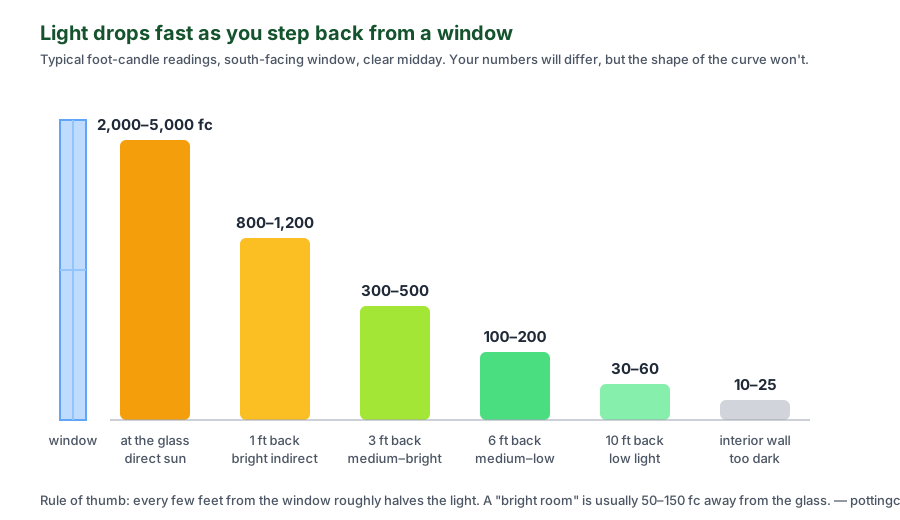
Typical readings on a clear day, south-facing window:
| Distance from window | Foot-candles | Plant category |
|---|---|---|
| At the glass, in the sunbeam | 2,000-5,000+ | Direct sun |
| 1 ft back | 800-1,200 | Bright indirect |
| 3 ft back | 300-500 | Medium to bright |
| 6 ft back | 100-200 | Medium to low |
| 10 ft back | 30-60 | Low, borderline too dark |
| Interior wall | 10-25 | Too dark |
The practical takeaway: the difference between a thriving plant and a struggling one is often two feet. Move plants closer to the glass before you buy a grow light.
How to Measure Light in Foot-Candles
With a phone app
Search "light meter" or "lux meter" in your app store. Most use the phone's ambient light sensor (the one that dims your screen), a few use the camera.
- Open the app and choose fc or lux
- Hold the phone where the leaves are, sensor facing the window
- Read the number
- Repeat mid-morning, midday and mid-afternoon
- Use the average, and note sunny vs cloudy
Expect ±20% error. That is fine for placing plants; you are deciding between 100 and 500, not between 480 and 520. For a step-by-step walkthrough with the app settings that matter, see How to Measure Light for Plants With Your Phone.
With a dedicated meter
A $15-50 light meter is more consistent and reads higher values accurately (phone sensors often max out around 2,000-3,000 fc in direct sun). Same method: hold the sensor at leaf height, facing the light source.
Measuring a grow light
Grow lights are rated in lumens, watts or PPFD, none of which tell you what the plant gets. Measure at leaf level with the light on and natural light blocked or accounted for. A "1,000 foot-candle grow light" only delivers 1,000 fc at the distance the manufacturer tested, usually 6-12 inches; at 24 inches it may be 250 fc. See Grow Lights for Houseplants: A Simple Guide.
Add natural and artificial light together
Readings add. Natural light 150 fc plus a grow light adding 250 fc gives 400 fc, which moves a plant from the low band into the medium band.
Light Duration Matters Too
Intensity is only half the story. Plants respond to the total light they receive over a day.
- 6 hours at 500 fc delivers about the same energy as 3 hours at 1,000 fc
- Most houseplants want 8-12 hours of adequate light and some hours of darkness
- Winter days are shorter and dimmer, so the same window delivers far less total light from November to February
This is why a plant that thrived all summer at 300 fc can decline in winter at the same spot: the intensity dropped to 150 fc and the hours dropped from 12 to 8.
Seasonal Changes
Measure once per season if you can. A south window in June and the same window in December are different environments.
- Summer: highest intensity, longest days, sun higher in the sky (less direct sun reaches deep into the room)
- Winter: lowest intensity, shortest days, sun lower in the sky (direct sun reaches further into the room, which can surprise plants set back from the glass)
- Spring and fall: in between, and the times when moving plants closer or further is easiest
Common Mistakes
Trusting how bright the room looks
Human eyes adjust in seconds. Plants can't. A room that feels bright is often 50-100 fc. Measure.
Ignoring distance
"Near the window" and "at the window" can differ by 5x. Two feet matters.
Forgetting obstructions
Sheer curtains cut 20-50%. Blinds, overhangs, trees and the building across the street can turn a south window into a north one. Measure the spot, not the direction.
Assuming all windows are equal
Same room, different windows, wildly different light. See Window Direction Guide (North/South/East/West).
Troubleshooting
Signs of too little light
Leggy stems with long gaps between leaves, new leaves smaller than old ones, variegation fading to green, no growth for months, soil staying wet for weeks. See Why Is My Plant Not Growing?.
Signs of too much light
Bleached or washed-out patches, crispy brown spots on the side facing the window, leaves curling away from the light, wilting at midday despite moist soil. See How to Tell If Your Plant Is Getting Too Much Sun.
Adjusting
Too low: move closer to the glass, switch to a brighter window, or add a grow light. Too high: move back a foot or two, add a sheer curtain, or rotate to an east window. Re-measure after every move.
Frequently Asked Questions
How many foot-candles do houseplants need?
Most want 200-1,000 fc. Low-light plants survive at 50-150 fc, medium-light plants want 150-500 fc, bright-indirect plants want 500-1,000 fc, and sun-lovers want 1,000 fc or more.
How many foot-candles is bright indirect light?
About 500-1,000 fc, with no sunbeam directly on the leaves. Measured 1-3 feet from a south or west window, or right in an east window.
What is fc in light measurement?
fc stands for foot-candle: the light from one candle at a distance of one foot, falling on one square foot. It measures the light arriving at a surface, which is what a leaf cares about. Lux is the metric version; 1 fc is about 10.76 lux.
Is 1,000 foot-candles a lot?
For a room, yes; for a plant, it is the top of bright indirect light. An overcast day outdoors is around 1,000 fc, direct sun is 5,000-10,000 fc.
Do I really need a light meter?
Not strictly, but it turns a guess into a number. Most people who measure discover their "bright" spot is 100-200 fc and move their plants closer to the window the same day.
Can I convert foot-candles to lux?
Multiply fc by 10.76 to get lux, or divide lux by 10.76 to get fc. Most apps show both.
Is more light always better?
No. Every plant has a range. Above it, leaves bleach and burn; below it, growth stops. Match the plant to the reading.