How Many Foot-Candles Does Your Plant Need? Light Chart for 39 Houseplants
Foot-candle ranges for 39 common houseplants, from snake plant (75-200 fc) to monstera (200-500 fc) and cacti (1,000+ fc), based on university extension light ratings. Find your plant, measure your spot, and see if it gets enough light.
Potting Corner Team · Oct 9, 2026 · Updated Oct 9, 2026 · 10 min read
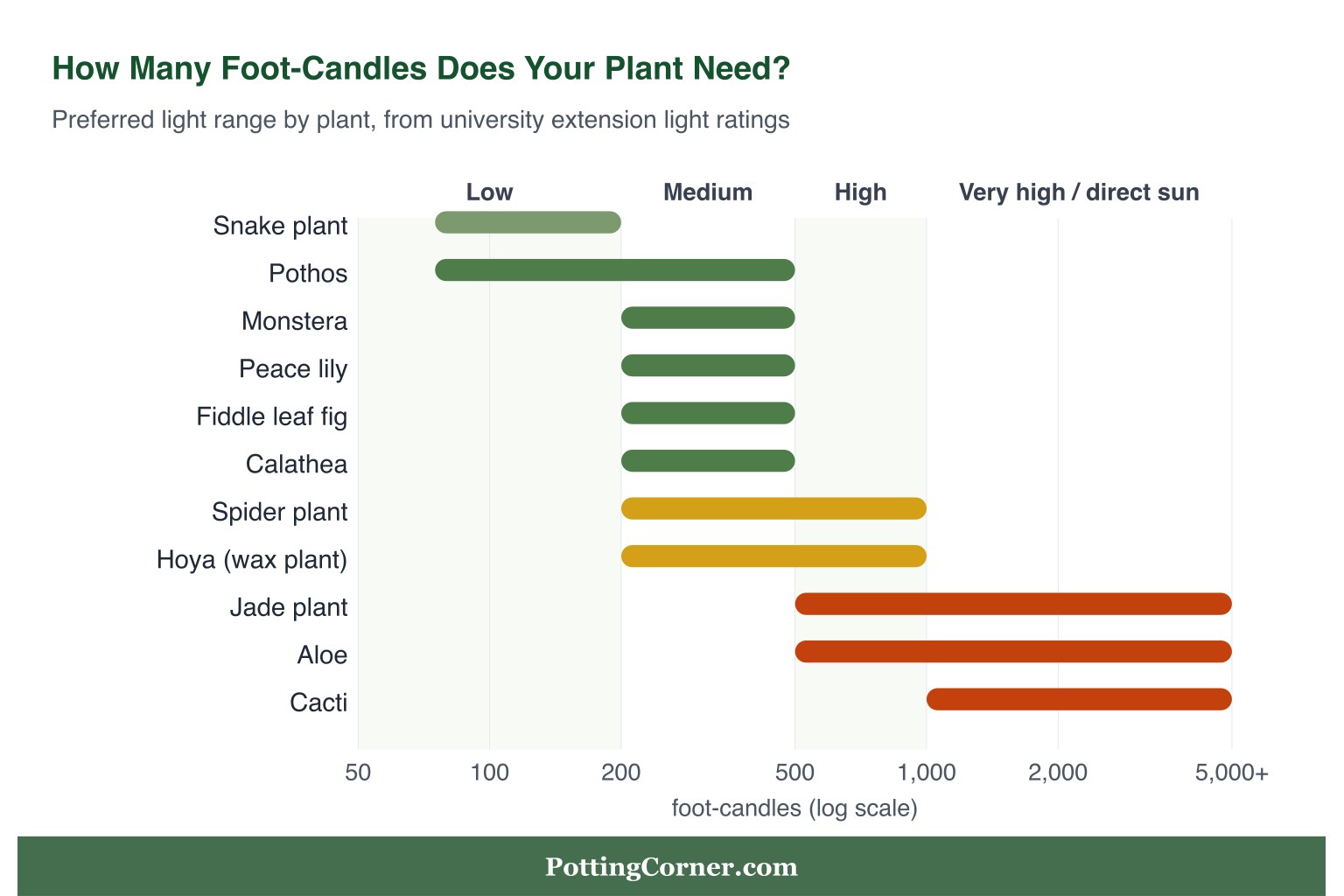
Short answer: low-light plants like snake plant, Chinese evergreen and cast iron plant grow well at 75-200 foot-candles. Most tropical foliage plants, including monstera, peace lily, rubber plant, fiddle leaf fig and calathea, want 200-500 fc. Spider plant, hoya and English ivy do best between 200 and 1,000 fc, and succulents, citrus and cacti need 500 to over 1,000 fc, which in most homes means direct sun at a window.
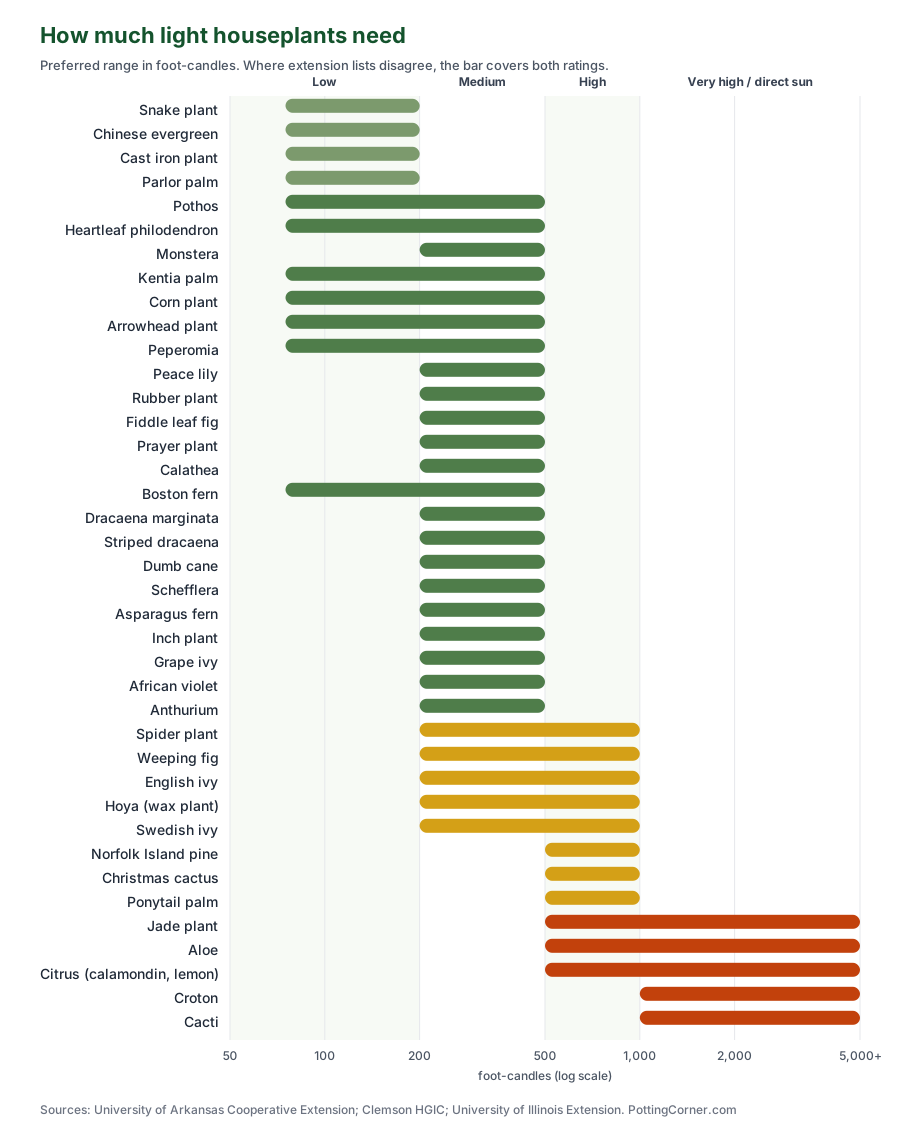
The chart and table below list 39 common houseplants. The ranges come from the light ratings published by three university extension services (Arkansas, Clemson and Illinois), converted to foot-candles using the definitions in those lists. If you haven't measured your spot yet, start with How to Measure Light for Plants With Your Phone; for what the numbers look like in a real room, see Foot-Candles for Plants: Light Levels Explained.
What the Light Ratings Mean
Extension plant lists rate indoor plants as low, medium, high or very high light. The University of Arkansas and Clemson lists define those ratings in foot-candles:
| Rating | Minimum to survive | Preferred for good growth | Typical spot |
|---|---|---|---|
| Low | about 25-100 fc | 75-200 fc | North window, or several feet back from an east window |
| Medium | about 75-150 fc | 200-500 fc | East window, or a few feet back from a south or west window |
| High | about 150-200 fc | 500-1,000 fc | Close to a bright south or west window |
| Very high | 1,000 fc | over 1,000 fc | Direct sun on the leaves for several hours |
"Minimum" means the plant can hang on there for a long time, but growth slows down or stops. The table below uses the preferred range, because that's where a plant actually grows.
Foot-Candle Chart by Plant
Where the extension lists disagree, the range covers both ratings. Lux values are rounded (1 fc ≈ 10.76 lux), so you can use a lux meter app too.
| Plant | Extension light rating | Grows well at | Lux (approx.) |
|---|---|---|---|
| Snake plant (Sansevieria (Dracaena trifasciata)) | Low | 75-200 fc | 810-2,200 |
| Chinese evergreen (Aglaonema) | Low | 75-200 fc | 810-2,200 |
| Cast iron plant (Aspidistra elatior) | Low | 75-200 fc | 810-2,200 |
| Parlor palm (Chamaedorea elegans) | Low | 75-200 fc | 810-2,200 |
| Pothos (Epipremnum aureum) | Low to medium | 75-500 fc | 810-5,400 |
| Heartleaf philodendron (Philodendron hederaceum) | Low to medium | 75-500 fc | 810-5,400 |
| Monstera (Monstera deliciosa) | Medium | 200-500 fc | 2,150-5,400 |
| Kentia palm (Howea forsteriana) | Low to medium | 75-500 fc | 810-5,400 |
| Corn plant (Dracaena fragrans) | Low to medium | 75-500 fc | 810-5,400 |
| Arrowhead plant (Syngonium podophyllum) | Low to medium | 75-500 fc | 810-5,400 |
| Peperomia (Peperomia) | Low to medium | 75-500 fc | 810-5,400 |
| Peace lily (Spathiphyllum) | Medium | 200-500 fc | 2,150-5,400 |
| Rubber plant (Ficus elastica) | Medium | 200-500 fc | 2,150-5,400 |
| Fiddle leaf fig (Ficus lyrata) | Medium | 200-500 fc | 2,150-5,400 |
| Prayer plant (Maranta leuconeura) | Medium | 200-500 fc | 2,150-5,400 |
| Calathea (Calathea / Goeppertia) | Medium | 200-500 fc | 2,150-5,400 |
| Boston fern (Nephrolepis exaltata) | Low to medium | 75-500 fc | 810-5,400 |
| Dracaena marginata (Dracaena marginata) | Medium | 200-500 fc | 2,150-5,400 |
| Striped dracaena (Dracaena deremensis 'Warneckei') | Medium | 200-500 fc | 2,150-5,400 |
| Dumb cane (Dieffenbachia) | Medium | 200-500 fc | 2,150-5,400 |
| Schefflera (Schefflera actinophylla) | Medium | 200-500 fc | 2,150-5,400 |
| Asparagus fern (Asparagus densiflorus 'Sprengeri') | Medium | 200-500 fc | 2,150-5,400 |
| Inch plant (Tradescantia) | Medium | 200-500 fc | 2,150-5,400 |
| Grape ivy (Cissus rhombifolia) | Medium | 200-500 fc | 2,150-5,400 |
| African violet (Saintpaulia) | Medium | 200-500 fc | 2,150-5,400 |
| Anthurium (Anthurium) | Medium | 200-500 fc | 2,150-5,400 |
| Spider plant (Chlorophytum comosum) | Medium to high | 200-1,000 fc | 2,150-10,800 |
| Weeping fig (Ficus benjamina) | Medium to high | 200-1,000 fc | 2,150-10,800 |
| English ivy (Hedera helix) | Medium to high | 200-1,000 fc | 2,150-10,800 |
| Hoya (wax plant) (Hoya carnosa) | Medium to high | 200-1,000 fc | 2,150-10,800 |
| Swedish ivy (Plectranthus) | Medium to high | 200-1,000 fc | 2,150-10,800 |
| Norfolk Island pine (Araucaria heterophylla) | High | 500-1,000 fc | 5,380-10,800 |
| Christmas cactus (Schlumbergera) | High | 500-1,000 fc | 5,380-10,800 |
| Ponytail palm (Beaucarnea recurvata) | High | 500-1,000 fc | 5,380-10,800 |
| Jade plant (Crassula ovata) | High to very high | 500-1,000+ fc | 5,380-10,000+ |
| Aloe (Aloe) | High to very high | 500-1,000+ fc | 5,380-10,000+ |
| Citrus (calamondin, lemon) (Citrus) | High to very high | 500-1,000+ fc | 5,380-10,000+ |
| Croton (Codiaeum variegatum) | Very high | 1,000-1,000+ fc | 10,760-10,000+ |
| Cacti (Cactaceae) | Very high | 1,000-1,000+ fc | 10,760-10,000+ |
How to Use the Chart
- Measure at leaf height, around midday, on a typical day for the season. A free phone light meter app is accurate enough for this.
- Compare with the plant's range. Below the bottom number, the plant is living on its reserves. Inside the range, it grows. Above the top number, for tropical foliage plants, watch for faded or scorched patches.
- Move the plant, not the number. Light falls off fast with distance: a few feet closer to the window often doubles the reading. See Which Window Is Best for Houseplants?.
- Re-check in winter. Days are shorter and the sun is weaker, so the same spot usually reads much lower in the darker months.
Why Some Plants Show a Wide Range
Light ratings aren't an exact science, and different extension services sometimes put the same plant in neighboring categories. Pothos, for example, is "low" in the Arkansas and Clemson lists and "medium" in the Illinois list. That tells you something useful: pothos survives at the low end but grows faster and keeps its variegation better toward the top of its range.
The same goes for most foliage plants. The extension ratings describe the light that keeps a plant healthy indoors over the long term. More light, up to the bright indirect range (500-1,000 fc), usually means faster growth, as long as hot afternoon sun doesn't land directly on leaves that aren't adapted to it. If you want a plant to grow rather than just hold on, aim for the upper half of its range.
Signs Your Plant Needs More or Less Light
| Too little light | Too much light |
|---|---|
| Long, stretched stems reaching toward the window | Bleached, washed-out patches on leaves |
| Small new leaves, slow or no new growth | Crispy brown edges or spots on the sunny side |
| Variegated leaves turning plain green | Leaves curling or folding during the day |
| Soil staying wet much longer than usual | Soil drying out within a day or two |
| Lower leaves yellowing and dropping | Red or bronze tint on succulents (often harmless) |
Low light also slows how fast a plant uses water, so the soil stays wet longer and the risk of root rot goes up. If a plant in a dim spot is declining, check the soil before adding more water. See How Long Should Soil Stay Wet After Watering? and How to Tell If Your Plant Is Getting Too Much Sun.
Frequently Asked Questions
How many foot-candles does a monstera need?
The University of Arkansas list rates Monstera deliciosa as a medium-light plant, which is 200-500 foot-candles. It survives with less, but growth slows and new leaves come in smaller. More light toward the bright indirect range speeds growth, as long as harsh direct sun doesn't scorch the leaves.
How many foot-candles does a snake plant need?
Snake plant is rated low light in all three lists: it grows well at 75-200 fc and tolerates less. It can also handle much brighter light, which is why it's so forgiving, but it grows faster with more light.
How many foot-candles does a pothos need?
About 75-500 fc. Pothos survives in low light but grows faster, with bigger leaves and better variegation, at 200 fc and above.
How many foot-candles does a fiddle leaf fig need?
Both the Arkansas and Clemson lists rate it medium light, 200-500 fc. Fiddle leaf figs are known for dropping leaves when moved, so find a bright spot near a window and keep it there.
How many foot-candles do succulents and cacti need?
Cacti are rated very high light (over 1,000 fc), and jade and aloe high to very high (500 to over 1,000 fc). Indoors, that means right at a sunny south or west window, or under a grow light. Stretched, pale growth is the sign they're not getting enough. See Grow Lights for Beginners.
How many foot-candles does a peace lily need?
Medium light, 200-500 fc. Peace lilies are often sold as low-light plants and do survive in dim rooms, but they rarely flower there.
Is 100 foot-candles enough for houseplants?
Only for low-light plants like snake plant, Chinese evergreen, cast iron plant and parlor palm. For most other houseplants, 100 fc is at or below the minimum, and growth slows to a crawl.
Can I use lux instead of foot-candles?
Yes. Multiply foot-candles by about 10.76 to get lux, or divide lux by 10.76 to get foot-candles. 200 fc is about 2,150 lux, 500 fc about 5,400 lux and 1,000 fc about 10,800 lux.
Sources
- University of Arkansas Cooperative Extension Service, Light and Moisture Requirements for Selected Indoor Plants.
- Clemson Cooperative Extension, Home & Garden Information Center, Indoor Plants: Cleaning, Fertilizing, Containers & Light Requirements.
- University of Illinois Extension, Houseplants: Lighting.
Related Guides
Plant Doctor
Yellow leaves, spots or bugs? Upload a photo and get the most likely cause with a day-by-day plan. Free.