White Powder on Plant Leaves: Powdery Mildew on Houseplants
A flat, flour-like white coating that spreads across leaf surfaces is usually powdery mildew. Learn how to tell it from mealybugs, hard water residue and dust, then fix it with better light and airflow and, if needed, a houseplant-labeled spray.
Potting Corner Team · Oct 19, 2026 · Updated Oct 19, 2026 · 9 min read
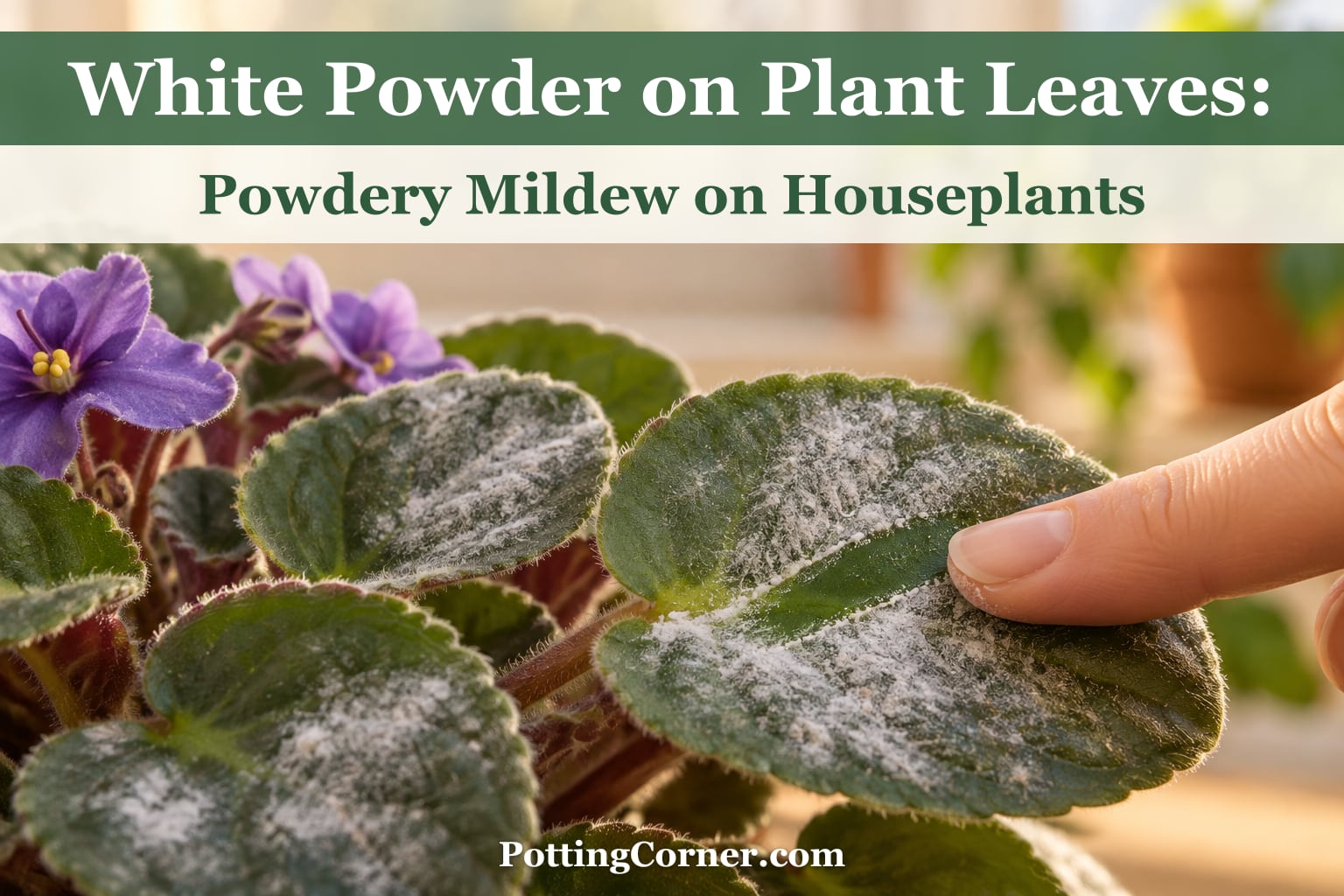
Short answer: a flat, white to gray, flour-like coating on the top of houseplant leaves, starting as small spots that spread and join, is usually powdery mildew. It's a fungus that grows on the leaf surface, and unlike most leaf diseases it doesn't need wet leaves. It thrives in shade, still air and moderate room temperatures. To fix it, isolate the plant, remove the worst leaves, move it to brighter light with better air circulation, and stop overfeeding. If it keeps spreading, use a houseplant-labeled sulfur, oil or Bacillus product. First make sure the white stuff isn't mealybugs, hard water residue or plain dust.
Plant Doctor
Not sure it's powdery mildew? Upload a photo and answer 3 quick questions.
For a broader overview of plant problems, see Houseplant Troubleshooting: Common Problems and Fixes.
The Direct Answer: Is It Powdery Mildew?
| What to check | Powdery mildew | Probably something else |
|---|---|---|
| Texture | Flat, dusty, flour-like film on the leaf surface | Raised cottony clumps, or hard crystals |
| Pattern | Roundish white spots that grow and merge | Even film on every leaf, or rings where water dried |
| Location | Upper leaf surfaces, stems and flowers | Leaf joints and undersides, or pot rim and soil |
| After cleaning a leaf | New white spots return and spread | Stays clean |
| Close-up | No insects | Oval bodies that squash, or nothing but dust |
The rule: white spots that keep growing and spreading across living green leaves, with no insects and no crust on the pot, are powdery mildew.
What Does Powdery Mildew Look Like?
- White powdery spots that expand as the infection grows (UC IPM)
- A white powdery coating on the surfaces of leaves and stems (University of Maryland Extension)
- Dry, brown, papery leaf spots on some plants instead of obvious powder (Clemson)
- On begonias, advanced cases can show reddish margins of dead tissue around the spots, and some varieties show only dark, bruised-looking areas with little visible powder (Pacific Northwest Plant Disease Handbook)
UC IPM notes that indoors it occurs often on grape ivy, kalanchoe, begonias and pileas. The University of Maryland also mentions poinsettia.
How to Confirm It (Not Mealybugs, Hard Water or Dust)
A three-step check
- Look closely with a phone zoom. Mealybugs are oval, segmented insects up to about 4 mm long, covered in white wax, packed into leaf joints and undersides (RHS). Mildew has no bodies
- Check the pot. A white crust on the soil surface or pot, plus white crystals on leaves, points to mineral or fertilizer salt deposits (University of Maryland)
- Clean one leaf and wait a few days. Dust wipes away with a damp soft cloth (Iowa State Extension) and stays gone. Mildew spots come back and keep spreading
Powdery mildew vs. look-alikes
| Problem | What you see | How to tell it from powdery mildew |
|---|---|---|
| Powdery mildew | Flat white spots on upper leaves and stems | Spots expand and merge; no insects |
| Mealybugs | Cottony white clumps in leaf joints and undersides | Clumps are insects that squash; leaves often sticky |
| Hard water / mineral residue | White crystallized coating on leaves; crust on soil or pot | Follows where water sat or dried; doesn't grow into spreading spots |
| Dust | Dull gray film evenly over upper leaves | Wipes off with a damp cloth and doesn't return quickly |
If the white clumps turn out to be insects, see Mealybugs on Houseplants: How to Get Rid of Them. Webbing plus a dusty look and tiny pale speckles is a different pest: see Spider Mites on Houseplants: How to Spot and Get Rid of Them.
A note on hard water residue
The University of Maryland explains that hard water carries dissolved minerals such as calcium carbonate that can leave white crystallized coatings on leaves or a crust on the potting mix. Oregon State Extension adds that plants can leave white salt residue on their leaves as they transpire. These deposits don't spread like a fungus, but heavy buildup can still harm plants, so leach the soil and switch to water with fewer minerals.
If you're also seeing a white crust on the soil, see How to Refresh Soil Without Repotting.
Why Houseplants Get Powdery Mildew
Powdery mildew doesn't behave like other leaf diseases:
- It doesn't need wet leaves. UC IPM notes that unlike many diseases, it doesn't require moist conditions to grow
- Shade and still air. UC IPM says shade encourages it, and the University of Maryland points to poor air circulation
- Humidity around the plant. The University of Maryland says high humidity promotes infection
- Moderate temperatures. UC IPM gives 60-80°F as the favored range, with extreme heat above 90°F inhibiting it. That's normal room temperature
- Too much nitrogen. UC IPM notes that excess nitrogen produces lush foliage that favors fungal growth
- Susceptible plants. UC IPM notes each powdery mildew species attacks only specific plants, which is why it often hits a begonia or kalanchoe and leaves unrelated neighbors alone
How to Get Rid of Powdery Mildew: Treatment Schedule
Day 0: Isolate, remove and change the conditions
- Move the plant away from other susceptible plants
- Pick off the most heavily coated leaves and bag them. The University of Maryland recommends removing infected leaves
- Move the plant to brighter light and away from cold drafts (UC IPM). Avoid a sudden jump into hot direct sun, which can scorch leaves
- Space plants apart so air moves between them
- Water at the soil early in the day (UC IPM) and don't overwater (Clemson)
- Hold off on nitrogen-heavy fertilizer
The University of Maryland notes that in most homes, removing infected parts and improving air circulation should be enough.
Day 1: Optional spray if it keeps spreading
Choose one product labeled for houseplants and cover all leaf surfaces:
- Horticultural oil or neem oil. UC IPM says oils work best as eradicants, on existing mildew
- Sulfur. UC IPM describes sulfur as primarily preventive. Clemson also lists it for houseplant powdery mildew
- Bacillus biofungicide. Clemson lists Bacillus amyloliquefaciens; UC IPM mentions a Bacillus subtilis product
UC IPM gives 7- to 10-day intervals for repeat applications. Follow your product's label.
Two rules that prevent leaf burn
- Never apply an oil spray within 2 weeks of a sulfur spray (UC IPM)
- Don't spray in heat. Avoid sulfur above 85°F (Pacific Northwest Handbook) and oils near or above 90°F (UC IPM)
Day 14: Check new growth
Remove any newly infected leaves promptly and keep the brighter, airier spot.
Safety Notes (Plants, Pets and People)
- Least-toxic first. Leaf removal, light and airflow before any spray
- Test first. Spray one leaf and wait a couple of days before treating the whole plant
- Labels. Only use products labeled for houseplants, follow the label exactly, and spray outdoors or in a ventilated spot
- Children and pets. Keep them away until the leaves are dry, and store products out of reach
What Progress Looks Like
| Day | What you should see |
|---|---|
| Day 3 | No new white spots on cleaned leaves |
| Day 7 | Remaining patches not expanding; few or no new spots |
| Day 14 | New leaves are clean. Old leaves may keep yellow or brown marks where mildew was |
Old marks don't mean treatment failed. Watch the new leaves.
When to Give Up on the Plant
If mildew keeps returning despite better light and airflow, the plant or variety may simply be very susceptible in your conditions. Consider replacing it with a less susceptible plant rather than spraying indefinitely.
How to Prevent Powdery Mildew
- Give susceptible plants good light and moving air, especially begonias, kalanchoes, grape ivy and pileas
- Don't crowd plants on shelves and windowsills
- Go easy on nitrogen fertilizer
- Inspect new plants for white spots before bringing them home
Frequently Asked Questions
Can I just wipe the powder off?
Removing the worst leaves is recommended, but cleaning alone won't stop it. New spots keep forming until you fix the shade, still air or crowding that let it start.
Why does powdery mildew keep coming back?
Usually because the conditions haven't changed: shade, still air, crowding or lots of soft new growth from heavy feeding. Fix those, and spray only if it still spreads.
Will mildew spread to all my plants?
Not necessarily. UC IPM notes that each powdery mildew species attacks specific plants, so unrelated plants are less likely to be affected. Still, isolate the plant until it's clean.
Plant Doctor
Still unsure what the white powder is? Upload a photo and answer 3 quick questions.
Related Guides
- Houseplant Troubleshooting: Common Problems and Fixes
- Mealybugs on Houseplants: How to Get Rid of Them
- Spider Mites on Houseplants: How to Spot and Get Rid of Them
- How to Refresh Soil Without Repotting
- Indoor Plant Light Guide: Where to Place Houseplants
Sources
- Houseplant Problems, UC Statewide IPM Program, University of California
- Powdery Mildew on Vegetables, UC Statewide IPM Program, University of California
- Powdery Mildew on Indoor Plants, University of Maryland Extension
- Houseplant Diseases & Disorders, Clemson Cooperative Extension
- Begonia - Powdery Mildew, Pacific Northwest Pest Management Handbooks
- Mealybug (glasshouse), Royal Horticultural Society
- Mineral and Fertilizer Salt Deposits on Indoor Plants, University of Maryland Extension
- White spots from watering with hard water?, Oregon State University Extension
- Dust has accumulated on the foliage of my houseplants. How can I clean the plants?, Iowa State University Extension and Outreach