Scale Insects on Houseplants: How to Identify and Get Rid of Them
Small brown, tan or white bumps lined up along stems and leaf veins are usually scale insects. Confirm them with a fingernail test, scrape them off, then spray oil or soap weekly for 4-6 weeks to catch the crawlers that keep hatching.
Potting Corner Team · Oct 8, 2026 · Updated Oct 8, 2026 · 10 min read
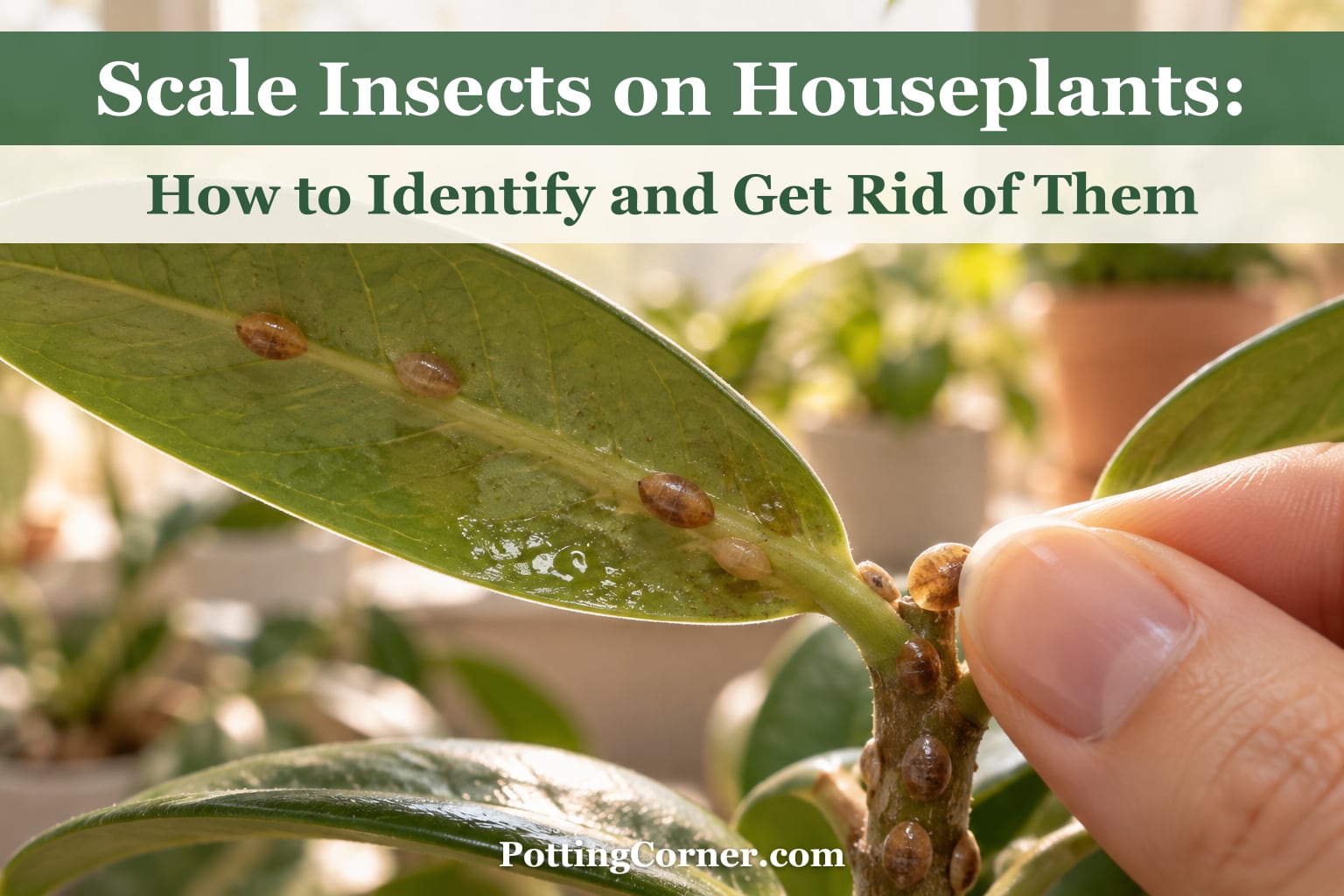
Short answer: small brown, tan, yellow or white bumps that sit still along stems and leaf veins, often with sticky leaves below, are almost always scale insects. They are sap-sucking insects under a protective shell, so they look like bumps rather than bugs. To get rid of them, isolate the plant, scrape off every bump you can find, prune heavily infested stems, then spray horticultural oil or insecticidal soap. Repeat every week for at least 4-6 weeks, because new crawlers keep hatching from under the mother scales.
Plant Doctor
Not sure those bumps are scale? Upload a photo and answer 3 quick questions.
For a broader overview of plant problems, see Houseplant Troubleshooting: Common Problems and Fixes.
The Direct Answer: Is It Scale?
| Sign | Scale insects | Probably something else |
|---|---|---|
| Fingernail test | Bump lifts off, leaving the leaf intact underneath | Bump is part of the leaf and won't lift |
| Position | Lined up along veins on leaf undersides, or on stems | Scattered randomly, or flat inside the leaf |
| Movement | Never moves once settled | Crawls or flies |
| Stickiness | Often sticky (soft scales) | Dry |
| Squash test | Live scale leaves a wet smear | Dry and crumbly (dead shell) or nothing |
The rule: bumps that lift off with a fingernail and sit along veins or stems are scale. Start treatment within 1-2 weeks.
What Do Scale Insects Look Like?
Soft scales and armored scales
Scale insects fall into two groups (Clemson):
- Soft scales are larger, more rounded and domed, up to about 1/4 inch (UC IPM). Their waxy coating is part of the body. They excrete sticky honeydew
- Armored scales are tiny and flat, about 1/25 to 1/8 inch, with a cover that can usually be lifted off the body (UC IPM). They don't produce honeydew
Colors range from pale yellow and tan to brown, grey or white. The soft scale Coccus hesperidum, pale yellow to brown, flat and oval, is one of the most widespread species indoors (RHS).
Crawlers and egg masses
- Newly hatched scales, called crawlers, are yellow to orangish and are the only stage that walks (UC IPM)
- Crawlers settle and start feeding within a day or two of emerging, then stay put (UC IPM)
- Some species lay eggs under white, waxy, cottony fibers on stems or leaf undersides (RHS)
Where they hide
Indoor scales often sit close to the midrib or main veins on the underside of leaves (RHS), and on stems and leaf stalks. Iowa State describes them as small bumps clustered or lined up along stems and leaf veins.
Damage
- Sticky, shiny honeydew on leaves below the colony (soft scales), often with black sooty mold growing on it
- Ants visiting the plant
- Stunted growth, yellowing and leaf drop; severe infestations can kill a plant (Iowa State)
RHS names citrus, orchids and bay laurel among common indoor hosts.
How to Confirm It's Scale (Not Mealybugs or Natural Bumps)
The fingernail test
- Pick a bump on a vein or stem
- Push it sideways with a fingernail
- A scale insect pops off and leaves the plant surface intact underneath
- Press the removed bump on a tissue. A live scale leaves a wet smear; dead scales don't release fluid when squashed (UC IPM)
That last step matters later: RHS notes dead scales can stay firmly attached to the plant, so bumps left after treatment aren't always alive.
Scale vs. look-alikes
| Problem | What you see | How to tell it from scale |
|---|---|---|
| Scale insects | Fixed brown, tan or white bumps along veins and stems | Lift off with a fingernail; often sticky |
| Mealybugs | Fluffy white clumps in leaf joints | Soft and cottony, and they crawl slowly. Some scale egg masses are cottony too, so look for a hard bump under the fluff |
| Whitefly nymphs | Flat, pale ovals on leaf undersides | Tiny white adults fly up when you move the plant |
| Nectar glands | Tiny colored dots or sticky droplets on leaf backs or leaf stalks | Part of the plant and usually under 1 mm; no insect lifts off |
| Edema | Small corky bumps under older leaves | Blisters in the leaf tissue itself; no honeydew |
| Leaf spot | Flat brown or black spots | Inside the leaf, not raised objects sitting on it |
| Sooty mold | Black film on sticky leaves | Wipes off. Look above it for the insects making the honeydew |
Natural nectar glands are not scale
Philodendron, alocasia, colocasia and other aroids have extrafloral nectaries: small glands outside the flower that release sticky, sugary droplets (Plants For All Seasons). They are usually under 1 mm, with a yellow, black, purple, green or wine-colored border, and they're harmless. If the sticky dots are part of the leaf and nothing lifts off with a fingernail, it isn't scale.
Why Scale Is So Hard to Get Rid Of
- Shell protection. Sprays mostly affect the young stage (RHS). Horticultural oil is most effective on crawlers and young nymphs (UC IPM)
- Constant hatching. Iowa State notes insecticides are most effective against immature nymphs, which hatch on a rotating schedule
- Year-round breeding indoors. Scale in greenhouses can breed continuously throughout the year (RHS)
- Easy to miss. Young scales are tiny and look like part of the stem
- Ants. UC IPM notes ants attack the natural enemies of scale, protecting the colony
How to Get Rid of Scale Insects: Treatment Schedule
The schedule is built around crawlers. Settled adults are protected, but crawlers are exposed for a day or two before they settle. Weekly treatment catches each new batch before it forms a shell.
Day 0: Isolate, scrape and prune
- Move the plant away from others. Check the stems and leaf undersides of every nearby plant
- Scrape off every visible scale with a fingernail or a cotton swab. Iowa State recommends removing individual insects by hand
- Prune heavily infested stems and bag them (Iowa State, UC IPM)
- Wash honeydew and sooty mold off the leaves with water or soap and water and a soft cloth (UC IPM)
Day 1: Spray oil or soap
Once the plant is dry, spray a horticultural oil or insecticidal soap labeled for houseplants. Cover stems and both leaf surfaces, especially the undersides. UC IPM stresses that thorough coverage is critical for armored scales.
Every 7 days for 4-6 weeks: Inspect, scrape, spray
- Check stems and vein lines for new tiny scales, which are crawlers that have settled
- Scrape them off and spray again
- Iowa State recommends weekly applications for at least 4-6 weeks
Day 28 onward: If scale keeps coming back
- Judge success by new growth staying clean, and squash-test old bumps. Dry ones are dead shells
- For soft scale, RHS lists the nematode Steinernema feltiae as a biological control that can be used indoors
- A systemic houseplant insecticide is a last resort. UC IPM notes imidacloprid controls soft scales but not most armored scales, so it may not work if your scale is the flat, non-sticky kind
Safety Notes (Plants, Pets and People)
- Least-toxic first. Scraping, pruning and washing before oil or soap, and oil or soap before anything systemic
- Soap-sensitive plants. Clemson lists ornamental ivy, maidenhair fern, dieffenbachia, schefflera, crown of thorns, chrysanthemum, lilies (Easter lilies during bud formation, Asiatic and oriental lilies), jade plant, begonia, fuchsia, zebra plant, impatiens and certain palms among plants that insecticidal soap can injure. Test a few leaves first; Clemson notes injury may take at least 48 hours to show
- Labels. Only use products labeled for indoor houseplants. Spray outdoors or in a ventilated spot if possible, and let the plant dry before bringing it back
- Systemic insecticides: keep away from children and pets, follow the label exactly, and don't use them on plants that go outdoors to flower, since neonicotinoids harm bees and other pollinators. They can also trigger spider mite outbreaks
What Progress Looks Like
| Day | What you should see |
|---|---|
| Day 3 | Visible scales removed; no new honeydew collecting |
| Day 7 | A few new tiny scales (settled crawlers) may appear. Remove them and keep going |
| Day 14 | Fewer new scales at each check; no fresh stickiness |
| Day 28 | New growth stays clean; remaining old bumps don't smear when pressed. Keep checking monthly |
Old yellowed leaves won't recover. Judge progress by the stems and new leaves.
When to Give Up on the Plant
Heavily encrusted stems are best pruned out. Iowa State and CSU both advise discarding severely infested plants, which is often the sensible choice for a small or inexpensive plant covered in scale. For a valued plant, keep up weekly treatment; if scale is still turning up after 6-8 weeks, consider a systemic product or professional advice.
How to Prevent Scale Insects
- Quarantine new plants. Clemson recommends isolating new plants for six weeks and checking them about once a week, paying attention to leaf undersides
- Look along veins and stems each time you water. Early scale is easy to scrape off
- Control ants that visit your plants (UC IPM)
- Treat stickiness as a warning. Honeydew on leaves or furniture means a sap-feeding insect is above it
Frequently Asked Questions
Can scale spread to my other plants?
Yes. Newly hatched crawlers actively crawl over the plant surface (RHS), and they can reach touching or nearby plants. Isolate the plant and check its neighbors.
Why are there still bumps after treatment?
RHS notes dead scales can stay firmly attached. Press one on a tissue: no wet smear means it's dead. Scrape them off so you can spot new ones.
Can I just wipe the scale off?
For a light infestation, scraping is the first step, but crawlers and eggs you can't see survive. Follow up with weekly oil or soap sprays for 4-6 weeks.
What's the sticky stuff and black film on my plant?
The sticky film is honeydew from soft scales, and the black film is sooty mold growing on it. Sooty mold doesn't infect the plant and washes off, but it returns until the scale is controlled (UC IPM).
Plant Doctor
Still unsure what the bumps on your plant are? Upload a photo and answer 3 quick questions.
Related Guides
- Houseplant Troubleshooting: Common Problems and Fixes
- Mealybugs on Houseplants: How to Identify and Get Rid of Them
- Spider Mites on Houseplants: How to Spot and Get Rid of Them
- Yellow Leaves on Houseplants: What's Wrong
- Houseplant Pests Identification Guide
Sources
- Pest Notes: Scales, UC Statewide IPM Program, University of California
- Scale insects, Royal Horticultural Society
- Indoor plants: sap-feeding insects, Royal Horticultural Society
- Common Houseplant Insects & Related Pests, Clemson Cooperative Extension
- Diagnosing Houseplant Problems Caused by Insect Pests, Iowa State University Extension and Outreach
- Houseplant pests, Colorado State University
- Edema of Indoor Plants, University of Maryland Extension
- Pest Notes: Sooty Mold, UC Statewide IPM Program, University of California
- Extrafloral nectaries in houseplants, should you be concerned?, Plants For All Seasons