Fungus Gnats: Causes and How to Get Rid of Them
Small black flies hovering around your plant's soil are almost always fungus gnats, and constantly wet potting mix is the cause. Let the soil surface dry, trap the adults and treat the larvae with Bti for 3-4 weeks.
Potting Corner Team · Sep 29, 2026 · Updated Sep 29, 2026 · 9 min read
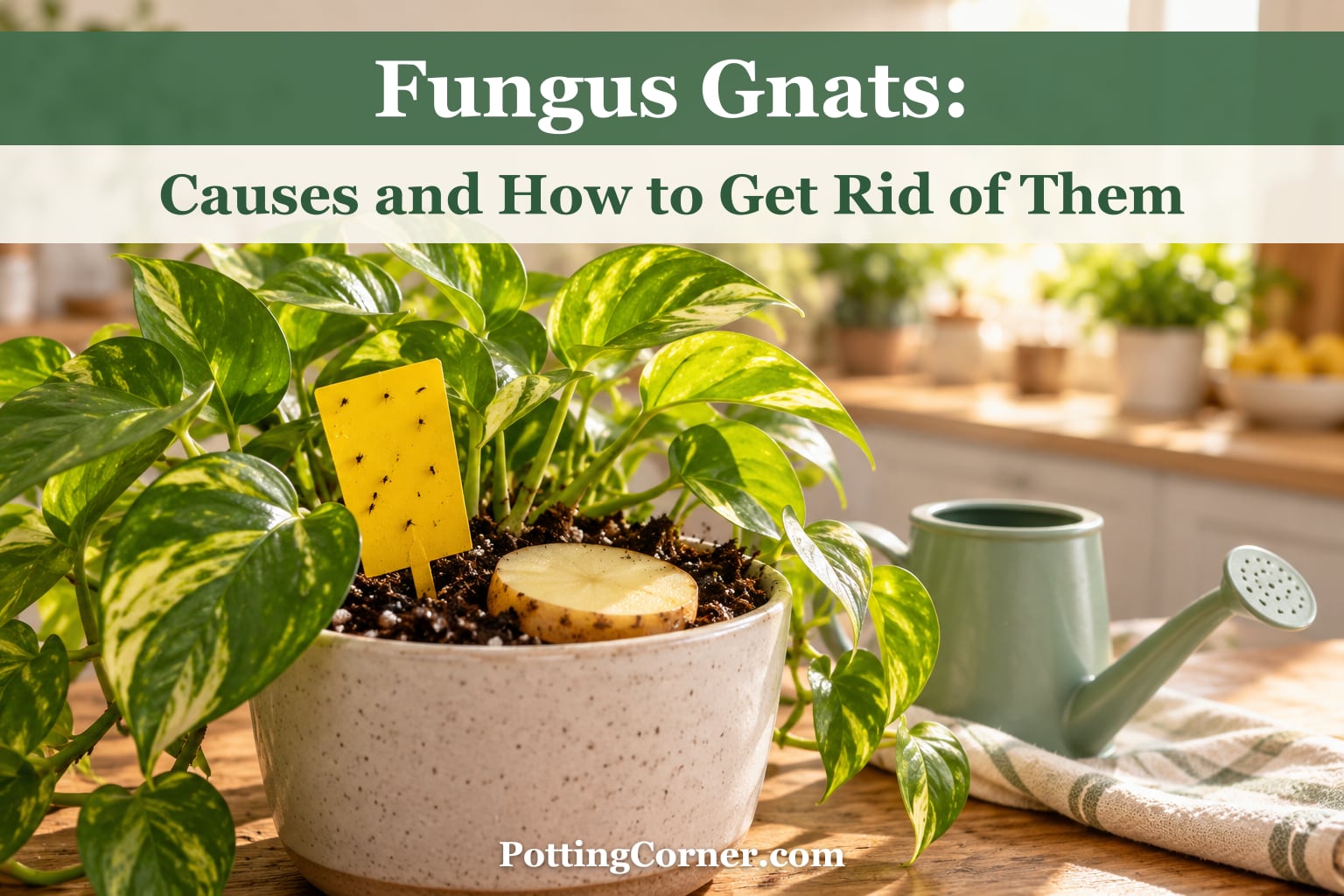
Short answer: those small black flies walking on the soil or flying weakly around your pots are fungus gnats. They breed in potting mix that stays wet, so the main cure is letting the soil surface dry out between waterings. Add yellow sticky traps for the adults and a Bti (Bacillus thuringiensis israelensis) soil drench for the larvae, repeated every 5-7 days for 3-4 weeks. The adults don't damage plants; the larvae can hurt seedlings and cuttings, but established plants are unlikely to be harmed (RHS).
Plant Doctor
Not sure they're fungus gnats? Upload a photo and answer 3 quick questions.
For a broader overview of plant problems, see Houseplant Troubleshooting: Common Problems and Fixes.
The Direct Answer: What to Do Today
| Step | Why |
|---|---|
| Let the top of the potting mix dry out | Larvae need wet soil to survive |
| Empty saucers and cachepots after watering | Standing water keeps the mix soggy |
| Put yellow sticky traps in the pots | Catches adults and shows you the numbers |
| Water in a Bti product at label rate | Kills larvae in the soil |
| Repeat Bti every 5-7 days for 3-4 weeks | New eggs keep hatching |
The rule: fungus gnats are a watering problem first and a bug problem second. Fix the moisture and the gnats have nowhere to breed.
What Are the Tiny Black Flies Around My Plant's Soil?
Adults
- About 1/16 to 1/8 inch long (UC IPM); the RHS gives 3-4 mm
- Dark grey to black, delicate and mosquito-like, with long legs and long antennae
- Walk on the soil or fly weakly just above it
- Rise from the pot when you water or disturb it
- Often gather at nearby windows
Larvae
- Legless, whitish-to-clear bodies with a shiny black head (UC IPM)
- Up to 6 mm long (RHS)
- Live in the top layer of wet potting mix
- Feed mostly on fungi and decaying organic matter
Do fungus gnats hurt plants?
Adults don't damage plants; they're a nuisance (RHS, Iowa State). Larvae can damage roots and stunt growth, particularly in seedlings and young plants (UC IPM), and the RHS notes they can tunnel into soft cuttings. Established houseplants are unlikely to be damaged.
Why Do I Have Fungus Gnats?
Almost always, the potting mix is staying wet too long. Iowa State notes that the larvae thrive in wet soils and are a sign of overwatering. Other factors:
- Water left standing in saucers or decorative cachepots
- Peat-rich, organic potting mixes
- Warm rooms: at 75°F a generation can go from egg to egg-laying adult in about 17 days (UC IPM)
- An open bag of potting mix stored damp
Plants that are kept moist, such as peace lily, Boston fern, calathea, pothos, philodendron and monstera, are common hosts.
If the plant is also yellowing or wilting in wet soil, the gnats are a symptom of a bigger watering problem. See Overwatered Plant: How to Save It.
How to Confirm It's Fungus Gnats (Not Fruit Flies or Springtails)
The potato slice test
- Push a slice or chunk of raw potato, cut side down, into the soil surface
- Leave it for 2-4 days
- Lift it and look at the underside
- Tiny clear-white larvae with black heads mean fungus gnats are breeding in that pot
- Throw the potato away with the larvae attached
UC IPM recommends this method for monitoring larvae. It also tells you which pot is the source.
The sticky trap test
Cut yellow sticky traps into small squares, attach them to skewers and push them into the pots (UC IPM). Small dark flies caught within a few days, right at soil level, point to fungus gnats.
Fungus gnats vs. look-alikes
| Problem | What you see | How to tell it from fungus gnats |
|---|---|---|
| Fungus gnats | Small dark flies at the soil; larvae with black heads in wet mix | Fly weakly; potato slice shows larvae |
| Fruit flies / drain flies | Small flies in the kitchen | Gather around fruit, the bin or drains rather than plant pots |
| Springtails | Tiny white, grey or cream specks on soil after watering | Wingless and jump instead of flying; usually harmless |
| Whiteflies | Tiny white insects | White and live on leaf undersides, not the soil |
| Thrips | Tiny insects on sticky traps | Much smaller, slender, not mosquito-shaped |
| Overwatering | Yellowing, wilting plant in wet soil | Often happens alongside gnats; fix watering too |
| Root rot | Young plant declining | Unpot and check: brown, mushy roots mean rot, not larvae |
If a young plant is collapsing, check the roots with Root Rot: Causes and Treatment.
How to Get Rid of Fungus Gnats: Treatment Schedule
This schedule is timed to the roughly 17-day life cycle. You're stopping new larvae from maturing, while the existing adults die off on their own.
Day 0: Dry out the soil and set traps
- Let the top inch or two of potting mix dry before watering again. UC IPM: "Allow the surface of container soil to dry between waterings"
- Empty saucers and cachepots after every watering
- Place yellow sticky trap squares on skewers in each affected pot
- Optional: add potato slices to find which pots have larvae
For a better sense of how long your mix stays wet, see How Long Should Soil Stay Wet After Watering?.
Day 1: Treat the larvae with Bti
Water in a Bti product at label rate. These are sold as mosquito or gnat "bits" or as a gnat drench. Bti is a naturally occurring soil bacterium used as a biological larvicide, and Clemson Extension describes Bt products applied to soil as effective.
Day 7 onward: Repeat every 5-7 days for 3-4 weeks
Bti doesn't reproduce or persist indoors, so UC IPM says repeated applications at about five-day intervals may be needed. Sticky traps alone won't stop new hatches (Iowa State).
Alternative or add-on: Steinernema feltiae, beneficial nematodes watered into the soil. UC IPM says they work between 60° and 90°F in moist conditions.
Day 14: Repot heavy infestations
If gnats are still breeding after two weeks of drier watering and Bti, repot into fresh houseplant potting mix and discard the old mix. The RHS notes this removes eggs and larvae. See How to Repot Houseplants: The Complete Guide.
Safety Notes (Pets and Kids)
- Drier watering, sticky traps, Bti and beneficial nematodes are the least-toxic options, and they are usually all you need
- Skip chemical soil drenches. Iowa State notes that insecticides are frequently ineffective against fungus gnats
- Sticky traps catch whatever touches them. Place them low in the pot where pets and children can't reach them
- Labels. Only use products labeled for indoor use and follow the label rate
What Progress Looks Like
| Day | What you should see |
|---|---|
| Day 3 | Adults still flying and sticky traps catching many. This is normal: drier soil and Bti target the larvae, so adults that already emerged take a while to die off |
| Day 7 | Adult numbers starting to fall as the soil dries and larvae die |
| Day 14 | Few adults on the traps; potato slices show no larvae |
| Day 28 | Occasional or no gnats. A full life cycle has passed without breeding. Keep watering less often |
If the Gnats Won't Go Away
Fungus gnats are never a reason to throw out an established plant. If they persist despite drier watering and Bti:
- Check that they're actually fungus gnats, not fruit flies from the kitchen or drain flies
- Look for another source: an overwatered pot you haven't checked, or a damp open bag of potting mix
- Use potato slices in every pot to find the breeding site
How to Prevent Fungus Gnats
- Water only when the top of the mix is dry. See How to Know When a Plant Needs Water
- Never leave water in saucers or cachepots. See Do You Need a Cachepot?
- Use potting mix made for houseplants and store open bags sealed and dry. See Best Soil for Indoor Plants
- Keep sticky traps in susceptible pots as an early warning
- Use pots with drainage holes. See Drainage Holes: Why They Matter
Frequently Asked Questions
Are fungus gnats harmful to my plant?
Rarely. The RHS says adults don't damage plants and established plants are unlikely to be harmed by the larvae. Seedlings, soft cuttings and young plants are the ones at risk.
Will sticky traps alone get rid of fungus gnats?
No. Traps catch adults, but larvae keep developing in wet soil. Iowa State notes traps won't prevent new hatches. Combine them with drier watering and Bti.
Why do fungus gnats keep coming back?
Usually because the soil still stays wet for many days after watering. One overwatered pot can keep supplying new gnats to the whole room.
Can I keep watering on my normal schedule?
It's better to water by checking the soil than by the calendar. See How to Water Houseplants: The Beginner's Guide.
Plant Doctor
Still seeing flies after two weeks? Upload a photo and answer 3 quick questions to check what they are.
Related Guides
- Houseplant Troubleshooting: Common Problems and Fixes
- Overwatered Plant: How to Save It
- Root Rot: Causes and Treatment
- How to Water Houseplants: The Beginner's Guide
- Best Soil for Indoor Plants
Sources
- Pest Notes: Fungus Gnats, UC Statewide IPM Program, University of California
- Fungus gnats, Royal Horticultural Society
- Common Houseplant Insects & Related Pests, Clemson Cooperative Extension
- Houseplant pests, Colorado State University
- Diagnosing Houseplant Problems Caused by Insect Pests, Iowa State University Extension and Outreach
- Springtails, Colorado State University Extension