Thrips on Houseplants: How to Identify and Get Rid of Them
Silvery, scraped-looking patches dotted with tiny black specks usually mean thrips. Confirm them with a white-paper tap test and a sticky trap, then rinse and spray every 5-7 days for at least 4-6 weeks, because part of their life cycle happens in the soil.
Potting Corner Team · Oct 12, 2026 · Updated Oct 12, 2026 · 9 min read
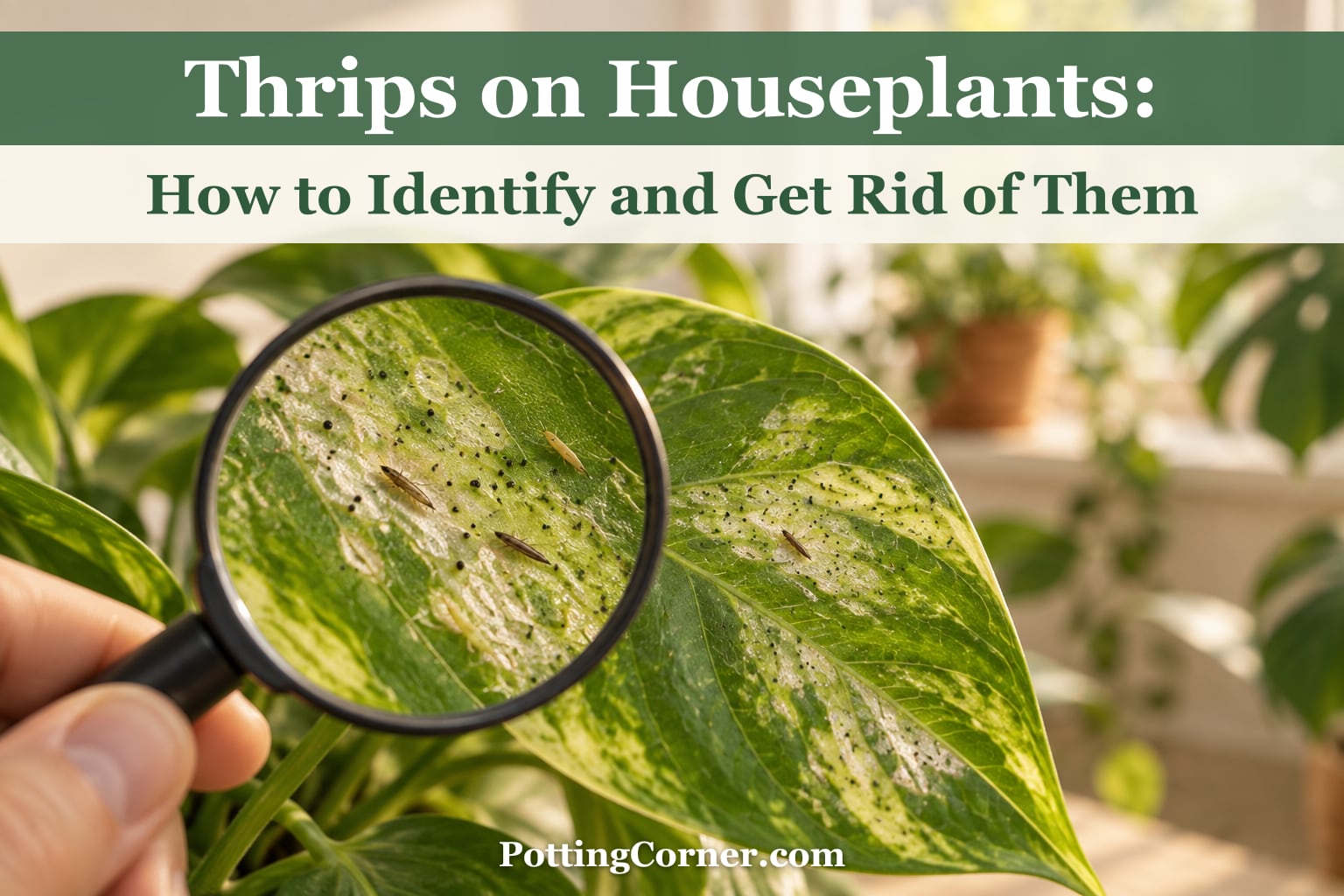
Short answer: silvery or bleached patches on houseplant leaves, dotted with many tiny black specks, are the classic sign of thrips. These are slender insects up to about 2 mm long that scrape the leaf surface and suck out the contents. Confirm them by tapping a leaf over white paper and looking for tiny, thin insects that run. To get rid of them, isolate the plant, rinse it, then spray insecticidal soap or horticultural oil on all leaf surfaces every 5-7 days for at least 4-6 weeks. Repeat treatment matters because eggs sit inside the leaf and many thrips finish developing in the soil, where sprays don't reach.
Plant Doctor
Not sure it's thrips? Upload a photo and answer 3 quick questions.
For a broader overview of plant problems, see Houseplant Troubleshooting: Common Problems and Fixes.
The Direct Answer: Is It Thrips?
| What to check | Thrips | Probably something else |
|---|---|---|
| Leaf surface | Silvery, shiny or bleached streaks and patches | Fine pale pin-prick dots, or no marks at all |
| Tiny dark specks | Many black dots scattered over the pale patches | No black dots |
| Paper tap test | Thin, rice-grain-shaped insects that run fast | Round, slow specks, or nothing moves |
| Webbing | None | Fine silk points to spider mites |
| New growth | Can be scarred, streaked or distorted | Normal |
The rule: silvery patches plus black specks is enough to start treatment. A sticky trap that catches slender insects confirms it.
What Do Thrips Look Like?
The insects
- Adults are narrow-bodied and up to 2 mm long, with two pairs of strap-like wings fringed with hairs (RHS)
- Adults range from yellowish-brown to blackish-brown; the wingless young (nymphs) are creamy yellow and paler (RHS)
- They are found on both leaf surfaces but are usually more numerous on the undersides (RHS)
- Adults can fly short distances (Colorado State University), which is how they reach other plants
What the damage looks like
- Leaves become dull, then develop silvery-white discoloration (RHS). Colorado State describes "irregular silver patches"
- Tiny black, varnish-like specks of excrement scattered on and around the patches (UC IPM, RHS)
- Scarred or distorted new growth. On flowering plants, petals can be flecked, streaked or distorted (Clemson, RHS)
- Damaged areas stay damaged. The RHS notes that leaves affected by thrips will not regain their green color
The RHS names two thrips that commonly affect indoor plants. Banded palm thrips favors tougher-leaved plants such as ficus, dracaena, citrus, monstera, schefflera and palms. Western flower thrips damages houseplants such as African violet, fuchsia, cyclamen and Primula obconica.
How to Confirm It's Thrips (Not Spider Mites or Broad Mites)
Two quick tests
- White-paper tap test. Hold white paper under a leaf or flower and tap sharply. Thrips show up as tiny, thin insects that run around. Spider mites are round and slow
- Sticky trap. Put a yellow or blue sticky trap next to the plant for a few days. UC IPM and Colorado State recommend yellow traps for monitoring; the RHS recommends blue. Either works.
Thrips vs. look-alikes
| Problem | What you see | How to tell it from thrips |
|---|---|---|
| Thrips | Silvery patches with black specks | Slender insects run on the paper; no webbing |
| Spider mites | Fine pale stippling, sometimes silky webbing | No black specks; mites are round, eight-legged and slow |
| Broad/cyclamen mites | Twisted, cupped, stunted new growth | Mites can't be seen without strong magnification; no silvery patches or black dots |
| Sunburn | Bleached patches on the window side | Appears after a move to brighter light; no specks, no insects |
If you see stippling and webbing rather than silvering, see Spider Mites on Houseplants: How to Spot and Get Rid of Them. If bleached patches appeared right after a move to a sunnier spot, see How to Tell If Your Plant Is Getting Too Much Sun.
Why Thrips Are Hard to Get Rid Of
Three parts of the thrips life cycle explain why one spray never works:
- Eggs are protected. Females lay eggs on or into leaves, buds and other plant parts (UC IPM), where contact sprays can't reach them
- Pupae hide in the soil. Colorado State notes that most species spend part of their development in soil. UC IPM says pupae drop to the soil or leaf litter or lodge in plant crevices
- Fast generations. In warm conditions, egg to adult can take as little as 2 weeks (UC IPM, Colorado State). The RHS gives 24-35 days under ideal glasshouse conditions, with breeding all year indoors
Thrips arrive on new plants, cut flowers and plants summered outdoors, and flying adults spread to nearby plants.
How to Get Rid of Thrips: Treatment Schedule
Soaps and oils kill only the insects they touch (Colorado State calls out "exposed life stages"). The schedule repeats treatment to catch young thrips as they hatch from leaf tissue and adults as they emerge from the soil.
Day 0: Isolate, trim and rinse
- Move the plant away from your other plants, and keep cut flowers away from houseplants
- Tap-test the neighbors too
- Cut off the worst-damaged leaves and any infested flowers or buds, and bag them
- Rinse the whole plant with lukewarm water, focusing on leaf undersides, leaf joints and new growth. Clemson lists rinsing leaves with water as a first step
- Clear fallen leaves and debris off the soil surface, since that is where pupae collect
Day 1: First spray and a trap
- Once the plant is dry, spray insecticidal soap or horticultural oil labeled for houseplants. Wet both leaf surfaces and aim into new, unfurling leaves
- Hang or stake a yellow or blue sticky trap beside the plant to track adults
Every 5-7 days: Repeat for at least 4-6 weeks
- Rinse and spray again, and do the tap test before each round
- Keep going until both the tap test and the sticky trap stay clean for 2 weeks
Week 3 and later: If thrips are still there
- Spinosad. Clemson lists spinosad among the options that work on thrips hidden in flower buds. Choose a product labeled for indoor ornamentals. UC IPM warns that spinosad is toxic to bees when sprayed and for about 1 day afterward, and says not to apply it to plants that are flowering
- Biological control. The RHS lists predatory mites (Amblyseius species), the predatory bug Orius laevigatus and other natural enemies from biocontrol suppliers
- Systemic granules such as imidacloprid are a last resort. Clemson lists imidacloprid granules on the soil as effective, but see the safety notes below
Safety Notes (Plants, Pets and People)
- Least-toxic first. Rinsing, then soap or oil, before anything stronger
- Soap-sensitive plants. Clemson lists ornamental ivy, maidenhair fern, dieffenbachia, schefflera, crown of thorns, chrysanthemum, lilies (Easter lilies during bud formation, Asiatic and oriental lilies), jade plant, begonia, fuchsia, zebra plant, impatiens and certain palms among plants that shouldn't receive insecticidal soap. Test a few leaves first; Clemson notes injury may take at least 48 hours to appear
- Labels. Only use products whose label allows indoor houseplant use. Spray outdoors or in a ventilated spot, and keep children and pets away until the plant is dry
- Spinosad and bees. Don't use it on flowering plants, and keep treated plants indoors
- Systemic insecticides: keep them away from children and pets, follow the label exactly, and don't use them on plants that go outdoors to flower, since neonicotinoids harm bees and other pollinators
What Progress Looks Like
| Day | What you should see |
|---|---|
| Day 3 | Fewer insects on the tap test. Silvery patches stay silvery |
| Day 7 | Few live thrips; sticky trap catches start to fall. Some young may still hatch from leaf tissue |
| Day 14 | Newly opening leaves are clean, with no new silvering or black specks |
| Day 28 | No thrips on tap tests or traps for 2 weeks. Trim damaged older leaves for looks if you like |
When to Give Up on the Plant
Heavily scarred, inexpensive plants can be discarded to protect the rest of a collection. If thrips keep coming back after 6 weeks of thorough treatment, switch to biological control or spinosad, and check every nearby plant and any cut flowers as a source of reinfestation.
How to Prevent Thrips
- Quarantine new plants. Clemson recommends isolating new plants for six weeks. Check leaf undersides and new growth with a magnifier or phone zoom
- Keep bouquets away from houseplants. Cut flowers can bring thrips indoors
- Leave a sticky trap near your collection as an early warning
Frequently Asked Questions
Why do thrips keep coming back after I spray?
Eggs inside the leaf and pupae in the soil survive contact sprays. That's why treatment has to be repeated for several weeks, and why clearing debris off the soil helps.
Will the silver patches go away?
No. The RHS notes that thrips-damaged leaves will not regain their green color. Success means new leaves come in clean.
Do thrips spread plant viruses?
Some do. UC IPM notes that western flower thrips can transmit plant viruses that affect vegetables and ornamentals, which is one more reason not to let them spread.
Plant Doctor
Still unsure what's causing the silver patches? Upload a photo and answer 3 quick questions.
Related Guides
- Houseplant Troubleshooting: Common Problems and Fixes
- Spider Mites on Houseplants: How to Spot and Get Rid of Them
- Mealybugs on Houseplants: How to Get Rid of Them
- Yellow Leaves on Houseplants: What's Wrong
- How to Tell If Your Plant Is Getting Too Much Sun
For every common pest in one place, see our houseplant pests identification guide.
Sources
- Pest Notes: Thrips, UC Statewide IPM Program, University of California
- Thrips, Royal Horticultural Society
- Indoor plants: sap-feeding insects, Royal Horticultural Society
- Common Houseplant Insects & Related Pests, Clemson Cooperative Extension
- Houseplant pests, Colorado State University
- Broad Mite and Cyclamen Mite, UC Statewide IPM Program, University of California