Perlite vs Vermiculite: Which One Should You Use for Houseplants?
Perlite adds air and drainage and never breaks down; vermiculite holds water and nutrients but compacts over time. For almost every houseplant, perlite is the one to buy. Here's when vermiculite makes sense, how much of each to add, and what to use instead.
Potting Corner Team · Oct 9, 2026 · Updated Oct 9, 2026 · 8 min read
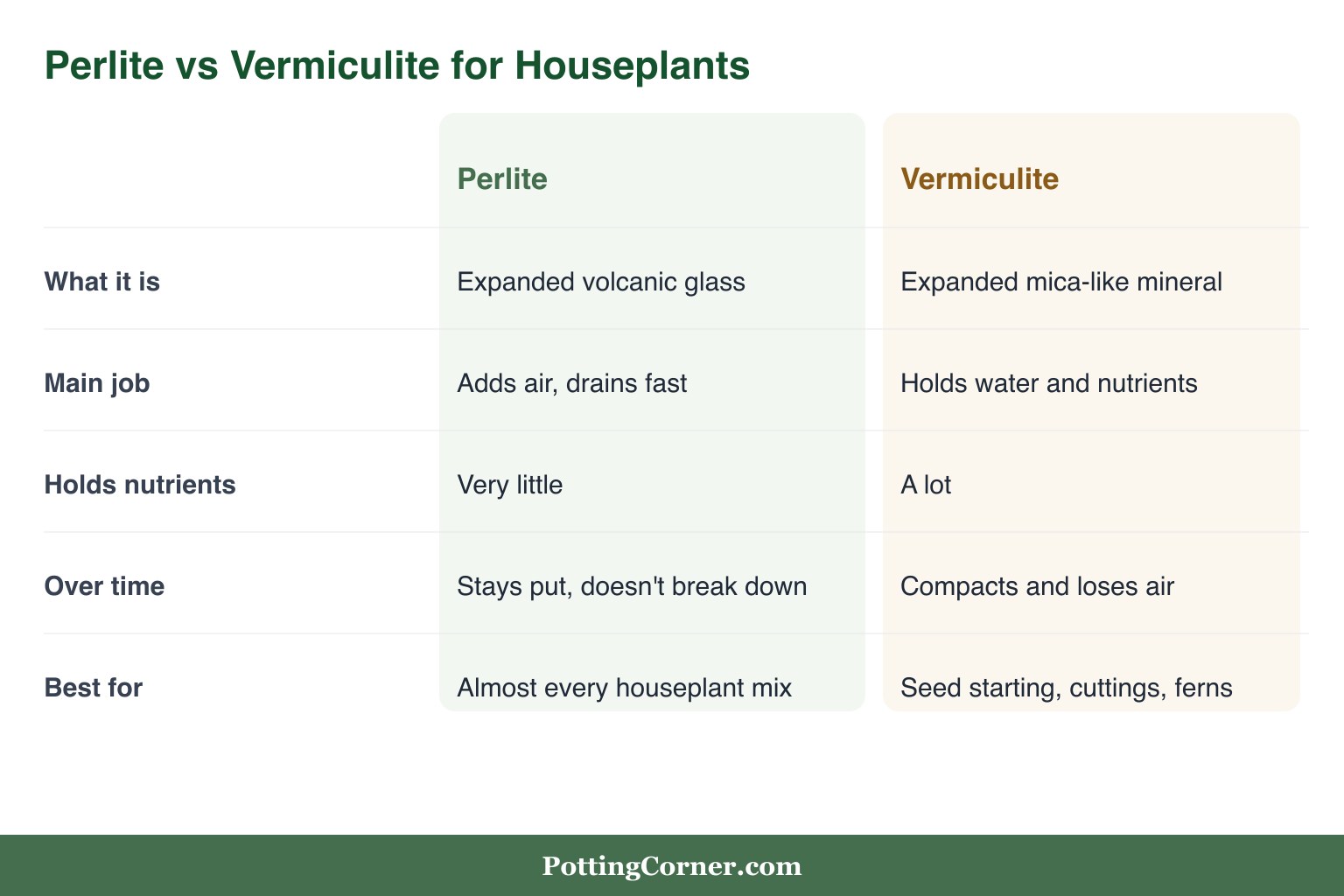
Short answer: for houseplants, use perlite. It's expanded volcanic glass that creates air pockets, helps water drain, and doesn't break down, which is exactly what indoor soil needs, because the most common way houseplants die is soil that stays wet too long. Vermiculite does the opposite job: it soaks up water and holds on to nutrients. That makes it useful for seed starting, rooting cuttings and a few moisture-loving plants, but a poor choice for most potted houseplants.
If you're mixing your own soil, the ratios for each plant type are in Best Soil for Indoor Plants. This guide explains what the two materials actually do, so you can pick the right one.
What Perlite Is
Perlite is a volcanic rock. Heated to roughly 1,400-1,800°F, it pops like popcorn into the light, white, crunchy granules you see in bagged potting mix. The heat also leaves it sterile.
In a pot, perlite does three things:
- Adds air. The irregular granules keep soil particles from packing together, leaving tiny air channels that roots need.
- Speeds up drainage. Water runs past perlite instead of sitting in the mix.
- Lasts. It doesn't rot or decompose, so it keeps doing its job for the life of the soil.
What it doesn't do is feed plants. Perlite holds almost no nutrients and has a roughly neutral pH, so it doesn't change the chemistry of your mix.
What Vermiculite Is
Vermiculite is a mica-like mineral that is also heated until it expands, this time into soft, golden-brown, accordion-shaped flakes. Like perlite, it comes out of the process sterile.
Its strengths are the opposite of perlite's:
- Holds water. The flakes soak up water like a sponge and release it slowly.
- Holds nutrients. Vermiculite has a high cation exchange capacity, meaning it grabs and holds fertilizer nutrients, and it contains calcium and magnesium.
- Breaks down. Its weak point is structure. Once wet, the flakes get squashed and the mix compacts, losing the air space that roots need.
Perlite vs Vermiculite at a Glance
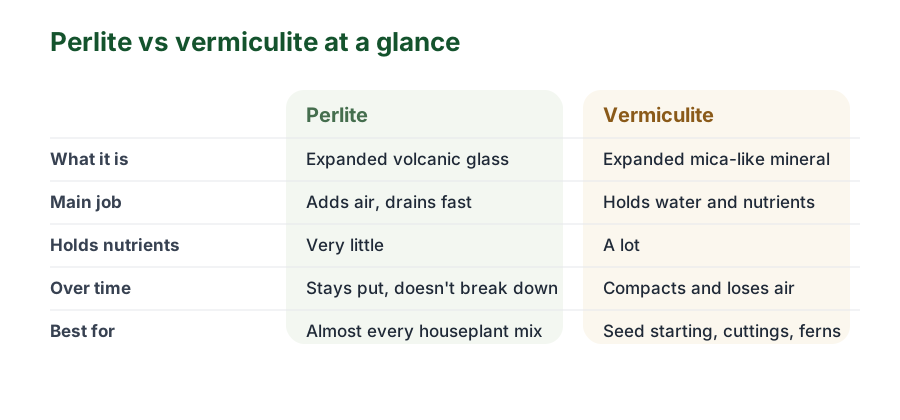
| Perlite | Vermiculite | |
|---|---|---|
| What it is | Expanded volcanic glass | Expanded mica-like mineral |
| Looks like | White, light, crunchy granules | Golden-brown, soft, shiny flakes |
| Main effect | More air, faster drainage | More water and nutrient holding |
| Nutrient holding | Very low | High |
| Structure over time | Stable, doesn't break down | Compacts after repeated wetting |
| Best for | Almost every houseplant mix, succulents, aroids | Seed starting, cuttings, moisture lovers |
| Avoid for | Plants that must stay evenly moist, if used in large amounts | Succulents, cacti, snake plants, anyone who overwaters |
Which One Your Plants Need
Most tropical houseplants: perlite
Pothos, philodendron, peace lily, dracaena, spider plant, rubber plant and most other common houseplants do best in a bagged indoor mix with 10-30% extra perlite by volume. Indoors, pots dry slowly: there's no wind, less light and a smaller surface for water to escape. Perlite is the cheap fix that keeps roots out of soggy soil. If your soil stays wet for more than about 10 days, start here: How Long Should Soil Stay Wet After Watering?.
Succulents, cacti, snake plant and ZZ: perlite (or pumice)
These plants rot quickly in wet soil, so use a lot of grit: up to half the mix can be perlite or pumice. Never add vermiculite to a succulent mix; holding water is the last thing it should do. See How to Water Succulents Indoors.
Monstera, philodendron and other aroids: perlite plus bark
Thick aroid roots need even more air. A common chunky mix is about 40% potting mix, 30% orchid bark, 20% perlite and 10% charcoal. Vermiculite has no place here.
Seeds and cuttings: vermiculite works well
Seedlings and fresh cuttings need steady moisture and nothing that rots. Vermiculite, alone or mixed with peat or coir, keeps them evenly damp. Once they have a few true leaves or a good set of roots, move them into a regular, perlite-lightened mix.
Ferns, calathea and African violets: a little of either
Moisture lovers can benefit from a small amount of vermiculite, which helps soil stay evenly moist. But even these plants hate soggy soil, so keep the share small and keep some perlite in the mix too. For most people, adding coco coir to hold moisture and perlite to keep it airy is the simpler route.
Can You Use Both Together?
Yes. Seed-starting mixes often combine them: vermiculite for moisture, perlite for air. For an established houseplant, though, there's rarely a reason to add vermiculite on top of a bagged potting mix, which already holds plenty of water through its peat or coir.
How to Add Perlite to Potting Mix
- Dampen the perlite first. Dry perlite is dusty. Lightly mist the bag or the bowl before you pour.
- Measure by volume, not weight: two scoops of mix to one scoop of perlite is about 33%.
- Mix thoroughly so the perlite is spread evenly and doesn't form layers.
- Pot as usual, then water until it drains from the bottom. See How to Repot a Houseplant.
A little perlite floating to the surface after watering is normal and harmless.
Alternatives to Perlite and Vermiculite
| Material | Acts like | Notes |
|---|---|---|
| Pumice | Perlite | Heavier, doesn't float to the top, great for succulents and tall plants |
| Orchid bark | Perlite (chunkier) | Big air gaps for aroids and orchids; slowly breaks down |
| Coarse sand | Perlite (weaker) | Use coarse, not fine play sand, which clogs soil |
| Coco coir | Vermiculite | Holds moisture, rewets easily, adds no nutrients |
| Peat moss | Vermiculite | Holds moisture; hard to rewet once bone dry |
Common Mistakes
- Adding vermiculite to fix "soil that dries too fast." Usually the real problem is a root-bound plant or a pot that's too small. Check the roots first.
- Using vermiculite for a plant that already struggles with overwatering. It makes the problem worse.
- Too much perlite for moisture lovers. A fern in 50% perlite will be thirsty all the time.
- Rocks in the bottom of the pot instead of perlite in the mix. A layer of gravel raises the wet zone instead of draining it. Mix the perlite through the soil. See How to Improve Drainage in Pots.
Frequently Asked Questions
Is perlite or vermiculite better for indoor plants?
Perlite, for nearly all of them. Indoor soil usually stays too wet, not too dry, and perlite fixes that while lasting for years. Vermiculite is mainly for seed starting and cuttings.
Can I use vermiculite instead of perlite?
Not as a direct swap. They do opposite jobs: vermiculite adds water holding, perlite adds air. If you're out of perlite, pumice, coarse sand or orchid bark are closer substitutes.
How much perlite should I add to potting soil?
About 10-30% for most houseplants, up to 50% for succulents, cacti, snake plants and ZZ plants.
Does perlite cause fungus gnats?
No. Perlite is sterile and gives gnat larvae nothing to eat. Gnats come from soil that stays moist; adding perlite helps it dry faster. See Fungus Gnats: Causes and How to Get Rid of Them.
Why is my perlite floating?
Perlite is very light, so loose granules near the surface float when you water. It's harmless. Pumice is the heavier alternative if it bothers you.
Does vermiculite hold nutrients?
Yes. It has a high capacity to hold nutrients and contains some calcium and magnesium, which is one reason it's popular for seedlings. Perlite holds almost none.
Sources
- University of Washington, Plant Growth Media and Fertilizer in the Nursery (properties of perlite and vermiculite).
Related Guides
Plant Doctor
Yellow leaves, spots or bugs? Upload a photo and get the most likely cause with a day-by-day plan. Free.