Tiny White Bugs in Plant Soil: Springtails vs Soil Mites (and When to Worry)
Tiny white bugs in houseplant soil are usually springtails or soil mites, and both are harmless. Use a 10-second jump test to tell them apart, let the soil dry more between waterings, and learn the signs that point to root mealybugs instead.
Potting Corner Team · Oct 5, 2026 · Updated Oct 5, 2026 · 10 min read
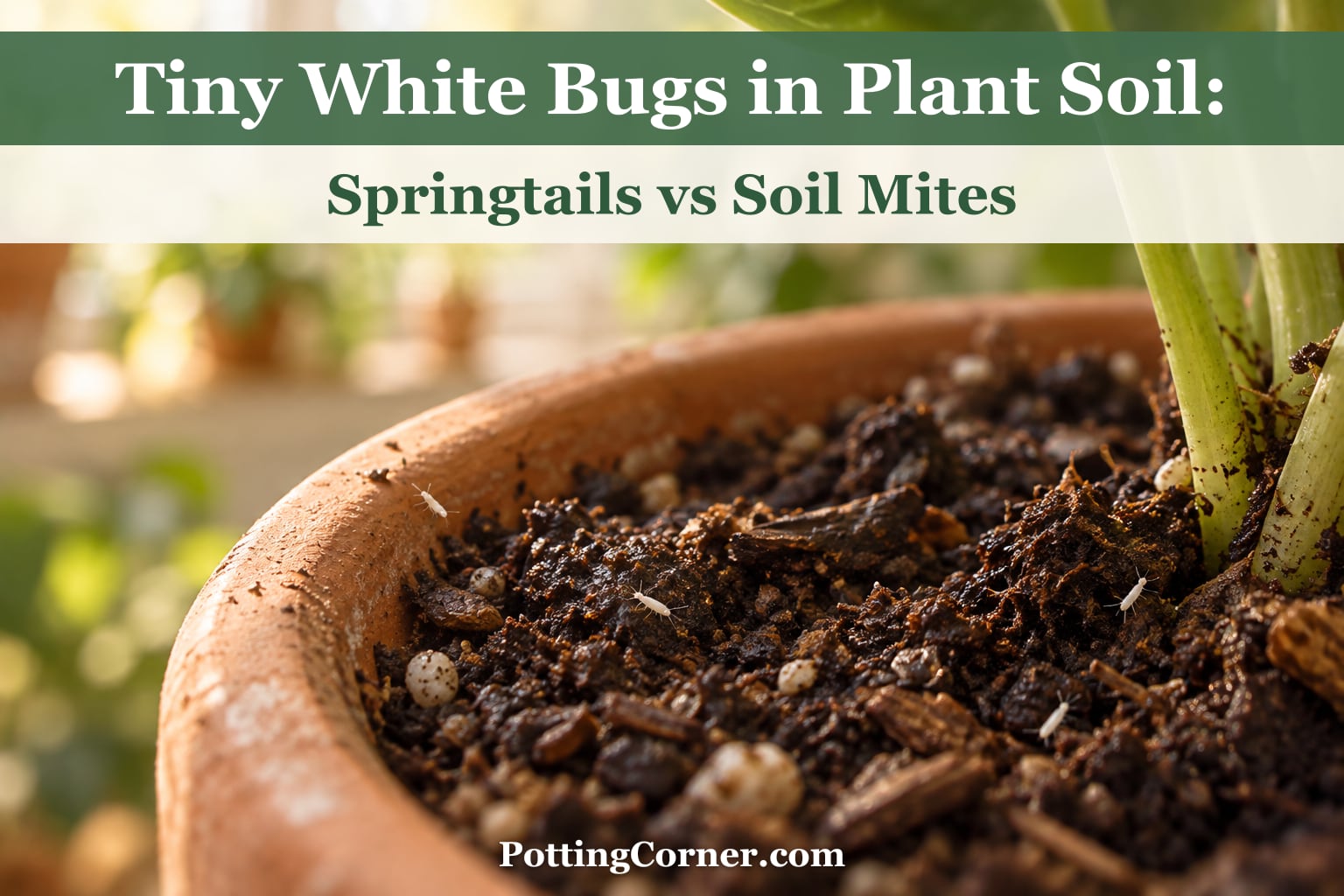
Short answer: tiny white bugs in houseplant soil are usually springtails (they jump when touched) or soil mites (they only crawl). Both feed on fungi and decaying organic matter, do little or no harm to houseplants, and need no pesticide. Their numbers usually mean the potting mix is staying wet, so the fix is letting it dry down more between waterings. Worry only if the plant itself is declining: then unpot it and check for root mealybugs or root rot.
Plant Doctor
Not sure what's crawling in your soil? Upload a photo and answer 3 quick questions.
For a broader overview of plant problems, see Houseplant Troubleshooting: Common Problems and Fixes.
The Direct Answer: Which Tiny White Bug Is It?
| What to check | Springtails | Soil mites | Root mealybugs |
|---|---|---|---|
| Touch with a toothpick | Jumps or vanishes | Keeps crawling | Barely moves |
| Where you see them | Soil surface and saucer, right after watering | Soil surface, pot rim, bits of bark and dead leaves | Roots, outer root ball, pot wall, drainage holes |
| What they look like | Pinhead-sized, white, cream, grey or purplish | Tiny round white or brown dots | Small oval bodies coated in white powdery wax |
| Harm to the plant | Little or none | None to healthy plants | Slow decline: yellowing, wilting, stunting |
| What to do | Water less often | Water less often, clear debris | Unpot, wash roots, repot |
The rule: if they jump or crawl on the soil and the plant looks healthy, they're harmless. If the plant is declining and there's white wax on the roots, treat it as root mealybugs.
Springtails: The Ones That Jump
What they look like
- Pinhead-sized: about 1.5 mm (CSU Extension) to 2 mm (Iowa State)
- Grey, cream or purplish bodies, plump and round or slender and elongated (CSU)
- Wingless. They jump using a fork-like structure folded under the body that snaps down and flings them a short distance (CSU Extension)
- Most noticeable on the soil surface after watering, when the soil is saturated
Why they show up
Springtails feed on fungi, algae, bacteria and decaying plant matter (CSU Extension). They need moisture, and Iowa State notes they tend to be abundant in overwatered houseplants. Clemson puts it plainly: their presence is usually a sign of overwatering.
Are they harmful?
On established houseplants, no. CSU Extension says they do very little, if any, damage to houseplants, and Iowa State calls them harmless. They can't bite and are harmless to people and pets (CSU Extension). The exception is very young plants: CSU notes high numbers can injure roots or tender foliage, and Clemson says they may chew seedlings or tender plant parts, though damage is usually minimal.
Soil Mites: The Ones That Only Crawl
What they look like
Soil mites are small white or brown mites crawling across the soil surface (UKHouseplants). They never jump and can't fly, and they stay at or just below the soil line. That last point separates them from spider mites, which live on the leaves and cause pale speckling.
Why they show up
The most common indoor soil mites are oribatid mites, decomposers that feed on fungi and decaying organic matter (University at Buffalo; UKHouseplants). They thrive in potting mix that stays moist or pots in darker spots, and they often arrive in potting mix or compost that already contained them (UKHouseplants). Oribatids are naturally very common in soil: the University at Buffalo Soil Ecology Wiki gives densities of 50,000 to 500,000 per square meter.
Are they harmful?
Not to healthy plants. UKHouseplants describes houseplant soil mites as harmless, feeding on rotten roots, bits of bark, other dead mites and organic matter rather than healthy tissue.
How to Confirm: The Toothpick Jump Test
- Water the plant, or wait until just after you normally water, when springtails come to the surface
- Touch the soil next to one of the bugs with a toothpick
- Jumps or suddenly disappears: springtail
- Keeps crawling steadily: soil mite
- Barely moves and has a white waxy coat: could be a root mealybug. Go to the next section
- Flies away: not either of these. Small dark flies around the soil are fungus gnats
Then check the leaves. Harmless soil bugs don't cause speckling, silvery patches, webbing or sticky leaves. If you see any of those, the soil bugs are a coincidence and something else is feeding on the plant.
When It's Actually Root Mealybugs
Root mealybugs are the one tiny white soil bug that matters. They feed on roots, so the plant slowly declines while the leaves look pest-free.
Signs that point to root mealybugs
- The plant is declining: slow growth, pale to yellowish or wilted leaves that may drop early (UC IPM)
- White powdery wax on the soil surface near the stem or around the root ball (UC IPM)
- A bluish tint to the soil from the wax the insects secrete (NC State)
- Insects at the drainage holes. NC State notes they sometimes crawl out of drainage holes during watering and infest nearby plants
- Ants on the plant or soil near the base of the stem (UC IPM)
How to check
Slide the plant out of its pot. UC IPM says ground mealybugs concentrate on the outer part of the root ball, between the roots and the pot. Adults are up to 1/16 to 3/16 inch long, elongated and covered in powdery white wax (UC IPM). NC State notes they look superficially like springtails but move much more slowly. Some species also make fine waxy threads that net over the insect, which separates them from white perlite in the mix. Perlite never moves.
If you find them, isolate the plant and its saucer.
Not Tiny White Bugs: Fungus Gnat Larvae
If you dig into the top layer of wet mix and find tiny worms rather than bugs with legs, they're fungus gnat larvae. They're white or transparent and legless with a shiny black head (CSU). Clemson says they grow up to about 1/4 inch. The adults are the small black flies you see around the pot. Like springtails, they point to soil that stays wet. See Fungus Gnats: Causes and How to Get Rid of Them.
What to Do About Springtails and Soil Mites
No pesticide or soil drench is needed. The plan is about letting the soil dry, which removes the damp, fungus-rich conditions both need.
Day 0: Confirm and adjust watering
- Do the jump test and check the leaves, as above
- Empty any water standing in the saucer or cachepot
- Pick off dead leaves, moldy bits and old decaying bark from the soil surface
- From now on, let the mix dry down more between waterings. CSU Extension and Clemson both give this as the main fix. For how to tell when the soil is ready, see How to Know When a Plant Needs Water
Day 7: Check the plant, not just the bugs
Look for signs of an overwatered plant: soggy mix, yellowing leaves, wilting in wet soil. If you see them, fix the drainage or repot into fresh, well-draining mix. See Overwatered Plant: How to Save It. For typical drying times, see how long soil should stay wet.
Day 14: If numbers still bother you
- Replace the top layer of potting mix with fresh mix (UKHouseplants)
- If soil mites are throughout the root ball, UKHouseplants suggests washing them off the roots with warm water and repotting in fresh mix. See How to Repot a Houseplant: Step-by-Step Guide for Beginners
What Progress Looks Like
| Day | What you should see |
|---|---|
| Day 3 | Still visible after watering. This is normal |
| Day 7 | Fewer on the surface once the mix dries between waterings and debris is gone |
| Day 14 | Only the occasional springtail right after watering; plant unaffected |
A few springtails after watering are normal in any potting mix. The goal is a plant that isn't sitting in wet soil, not a soil with zero life in it.
When to Worry
- The plant is wilting, yellowing or not growing. Unpot it. Brown, mushy, bad-smelling roots mean root rot; see Root Rot: Causes and Treatment. Mites crowding on rotting roots are feeding on tissue that's already dead
- Shiny, pearl-like mites on rotting roots or bulbs. These may be bulb mites: shiny, creamy white, about 1/2 to 1 mm long, like "tiny pearls with legs" (UC IPM). They thrive alongside existing root and bulb rots, so deal with the rot first. UC IPM notes pesticides aren't practical against them in home settings
- Seedlings or cuttings are being chewed. Large springtail numbers can injure tender tissue (CSU), so keep the mix drier around young plants
- The bugs are on the leaves, or the leaves show speckling or stickiness. That's a different pest
Harmless soil bugs are never a reason to discard a plant.
How to Prevent Tiny Bugs in Soil
- Water only when the top of the mix has dried, not on a fixed schedule
- Empty saucers and cachepots after watering
- Keep the soil surface clean of dead leaves and decaying debris
- Improve airflow in damp rooms. CSU Extension suggests reducing moisture and improving ventilation
- Inspect roots when you repot or buy a plant. UC IPM notes root mealybugs are commonly introduced with new plants
Frequently Asked Questions
Are springtails a sign of root rot?
Not by themselves. They're a sign the soil stays wet, which is also what causes root rot. If the plant is healthy, just water less often. If it's declining, check the roots.
Will springtails or soil mites spread to my other plants?
They don't harm healthy plants, so it doesn't matter much. Soil mites can't fly and tend to stay in one pot. Root mealybugs are different: they crawl out of drainage holes into nearby pots, so isolate a plant that has them.
Should I use insecticide on soil bugs?
Not for springtails or soil mites. CSU Extension and Clemson both recommend letting the soil dry more between waterings, and UKHouseplants advises refreshing the top layer of mix rather than using pesticides.
Are these the same as spider mites?
No. Spider mites live on leaves, mainly the undersides, and cause pale speckling and webbing. Soil mites stay on the soil and don't damage leaves. See Spider Mites on Houseplants: How to Spot and Get Rid of Them.
Plant Doctor
Still unsure what's in your soil? Upload a photo and answer 3 quick questions.
Related Guides
- Fungus Gnats: Causes and How to Get Rid of Them
- Overwatered Plant: How to Save It
- Mealybugs on Houseplants: How to Identify and Get Rid of Them
- How to Water Houseplants: The Beginner's Guide
- Houseplant Pests Identification Guide
Sources
- Springtails, Colorado State University Extension
- Springtail, Iowa State University Extension and Outreach
- Houseplant pests, Colorado State University
- Common Houseplant Insects & Related Pests, Clemson Cooperative Extension
- Identifying & Addressing Houseplant Soil Mites, UKHouseplants
- Oribatida, University at Buffalo Soil Ecology Wiki
- Bulb Mites (Home and Landscape), UC Statewide IPM Program, University of California
- Ground (Root) Mealybugs, UC Statewide IPM Program, University of California
- Root Mealybugs, NC State Extension